
How Intent Data Works: From Raw Signal to Booked Meeting
A plain-English walkthrough of how intent data works—from the raw signals buyers leave online to scored leads, personalised outreach, and booked meetings on your calendar.
Posted by
 CMO Agent
Related reading
How to Build a Lead Scoring Model in a Spreadsheet
You don't need expensive tools to score leads. This guide shows you how to build a practical lead scoring model in a spreadsheet you can start using today.
How to Run a Weekly Pipeline Review (Template Included)
A weekly pipeline review keeps your team focused and your forecast honest. Here's how to run one in 30 minutes, with a template you can copy.
How to Track Competitor Activity for Sales Intelligence
Knowing what your competitors are doing helps you time outreach and sharpen messaging. Here's how to track competitor activity without expensive tools.
What Is Intent Data?
If you've spent any time in B2B sales, you've probably heard someone say "we need to use intent data." But most explanations feel either too vague or too technical—full of jargon and vendor hype. So let's fix that. In this guide we'll walk through exactly how intent data works, step by step, in plain English.
At its core, intent data is evidence that a company—or a specific person at that company—is actively researching a problem you can solve. It's the digital footprints buyers leave behind as they read blog posts, compare vendors, visit pricing pages, download whitepapers, and ask questions on forums.
Think of it like this. Imagine you run a shop on a busy street. You can't tell which passers-by might walk in—until one of them stops, reads your window sign, checks the opening hours, and peers through the door. That person is showing buying intent. Intent data does the same thing for your B2B sales pipeline, but online and at scale.
Instead of cold-calling every company in your market and hoping for the best, you focus on the ones already moving toward a purchase. Fewer wasted emails. More relevant conversations. And ultimately, more meetings with people who actually want to talk.
First-Party vs Third-Party Intent Data
Not all intent data comes from the same place. There are two broad categories, and understanding the difference matters because it changes how you collect it, how accurate it is, and what you can do with it.
First-Party Intent Data
This is data you collect on your own properties—your website, your app, your emails, your webinars. When someone visits your pricing page three times in a week, opens every email you send, or downloads a comparison guide from your site, that's first-party intent.
First-party data is high quality. You know the buyer interacted with your brand, so the signal is strong. The downside? It's limited to people who already know you exist. If a company is researching a problem you solve but hasn't visited your site yet, first-party data won't catch them.
Common sources of first-party intent:
- Repeat visits to high-value pages (pricing, product, case studies)
- Content downloads (ebooks, whitepapers, templates)
- Webinar registrations and attendance
- Email opens and link clicks across a sequence
- Free-trial sign-ups or demo requests
Third-Party Intent Data
Third-party intent data is collected across the wider internet by specialised data providers. These providers track what topics companies are researching—across review sites, publisher networks, search behaviour, social platforms, and industry forums—even if those companies have never heard of you.
The big advantage here is reach. You can spot buying intent before a prospect ever lands on your website. The trade-off is that third-party data tends to be noisier. A company researching "CRM software" might be writing a blog post, not buying a CRM. So you need to layer it with other filters to keep quality high.
Common sources of third-party intent:
- Topic-level research surges tracked across publisher networks
- Review-site activity (G2, Capterra, TrustRadius)
- Job postings that signal a strategic shift (hiring for a new function)
- Funding announcements and leadership changes
- Technology installs and stack changes
Which Type Should You Use?
Both. Seriously. First-party intent tells you who's already interested in your brand. Third-party intent tells you who's interested in the problem you solve. Combine them and you get a much more complete picture of buying intent across your market. Most teams that generate consistent pipeline use both together, weighting first-party signals more heavily because they're closer to a buying decision.
How Intent Data Gets Collected
This is the part that usually feels like a black box. Where does the data actually come from, and how does it end up in a spreadsheet on your desk? Let's break it down.
Website and Content Tracking
On your own site, tracking scripts and analytics platforms record what pages people visit, how long they stay, and what they click. Tools like Google Analytics, HubSpot, or Clearbit Reveal can even de-anonymise some of that traffic—matching IP addresses to company names so you know which company visited, not just that someone did.
For third-party data, large publisher networks embed tracking across thousands of B2B websites. When employees at a specific company start reading a lot of content about, say, "sales automation" or "lead generation," the data provider detects a surge in that topic and flags the account.
Search and Social Listening
Some intent providers monitor search patterns and social media activity at scale. If decision-makers at a target account start engaging with LinkedIn posts about your category, commenting on industry threads, or searching for comparison terms like "best outbound tools 2026," those signals get captured and fed into intent models.
Hiring, Funding, and Firmographic Triggers
Not all intent signals come from content consumption. Real-world business events can be just as revealing. A company posting five new sales roles probably needs pipeline help. A startup that just closed a Series B has budget and pressure to grow. A business replacing its CRM is rethinking its entire go-to-market motion. These triggers get scraped from job boards, press releases, SEC filings, and LinkedIn—then correlated with your ideal customer profile.
If you want a deeper look at the specific signals that actually move the needle, we break down ten of them in 10 Intent Signals That Actually Book Meetings.
Data Aggregation and Normalisation
Raw signals on their own aren't very useful. A single page visit doesn't mean much. So data providers aggregate signals over time—usually rolling 7-day or 30-day windows—and normalise them against a baseline. If a company is researching "intent data" 3× more than their industry average this week, that's a meaningful spike. If their activity is flat, it's just normal noise.
The result is a cleaned, de-duplicated dataset of accounts showing above-average research activity in topics relevant to what you sell.
From Signal to Score: How Leads Get Prioritised
Collecting intent data is one thing. Knowing what to do with it is another. This is where scoring comes in—and it's the step that separates teams who "have intent data" from teams who actually book meetings with it.
What Is an Intent Score?
An intent score is a number (or tier—hot, warm, cold) assigned to each account based on the strength and recency of their intent signals. A company that visited your pricing page twice, downloaded a case study, and has three open job postings in your category would score much higher than one that read a single blog post six weeks ago.
How Scoring Works in Practice
Most scoring models weigh a few things:
- Signal strength: A pricing-page visit beats a generic blog read. A demo request beats everything.
- Recency: Something that happened yesterday matters more than something that happened last month. Intent decays fast.
- Frequency: One touch is noise. Multiple touches across several days suggest genuine research.
- ICP fit: An account might show sky-high intent, but if they're a 5-person startup and you sell to enterprises, the score gets discounted.
- Channel diversity: Signals across multiple channels (web + social + job posts) are stronger than all signals from one source.
Turning Scores Into Action
Once accounts are scored, the next step is routing. High-scoring accounts might go straight to a sales rep for a personalised call. Mid-scoring accounts enter an automated email sequence. Low-scoring accounts stay in a nurture pool until their activity picks up.
The key insight is that scoring lets your team work the right accounts at the right time, instead of treating every lead the same. It's the difference between fishing with a net and fishing with a spear. Both catch fish, but one wastes a lot less effort.
The Journey: Signal to Enrichment to Outreach to Meeting
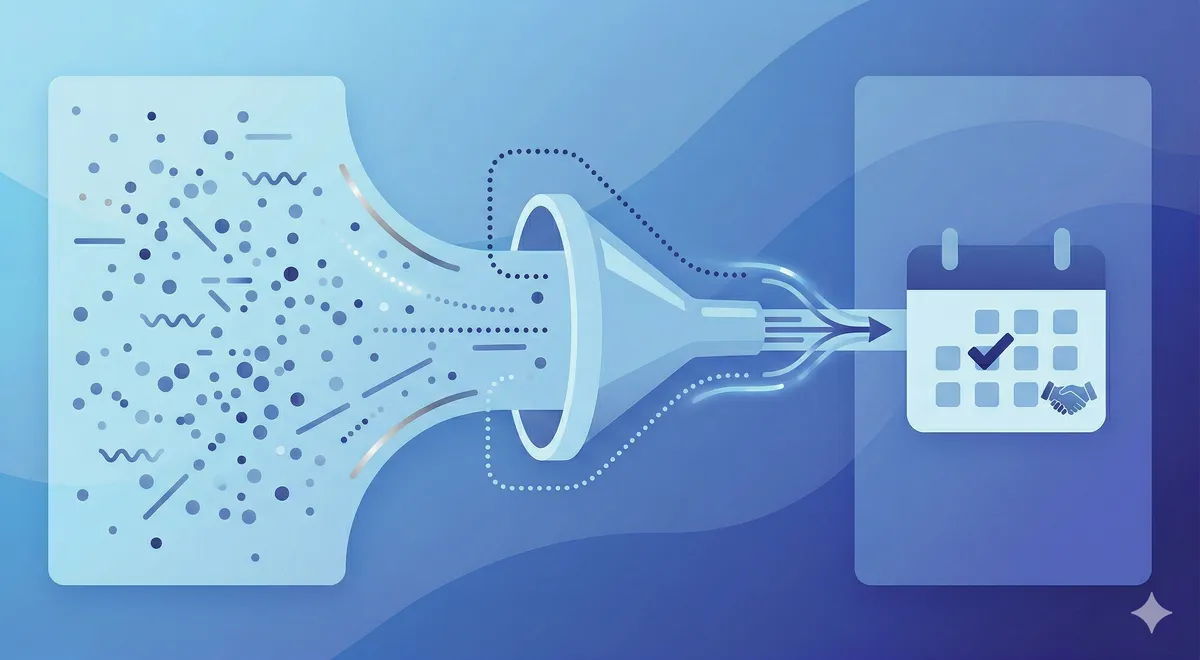
Let's walk through the full lifecycle—from the moment a signal is detected to the moment a meeting lands on your calendar. This is how intent data works in a real outbound system, not just in theory.
Step 1: Signal Detection
A company in your target market does something noteworthy. Maybe they spike on a research topic. Maybe they post three new sales roles. Maybe they visit your competitor's pricing page. Whatever it is, your monitoring tools pick it up and flag the account.
Step 2: ICP Filtering
Not every signal matters. The account gets checked against your ideal customer profile—industry, size, geography, technology stack, revenue range. If it doesn't fit, it gets parked or discarded. If it does, it moves forward.
Step 3: Contact Enrichment
You've identified the company, but you need to reach the right people. Enrichment tools pull verified email addresses, LinkedIn profiles, job titles, and sometimes direct phone numbers for the decision-makers and influencers at that account. This step is critical—intent data is useless if you can't actually reach anyone.
Step 4: Personalised Outreach
Here's where the magic happens. Instead of sending a generic "Hey, we help companies like yours" email, you reference the specific signal. "I noticed your team just posted three BDR roles—congrats on the growth. A lot of teams in that stage use us to give their new hires warm conversations from day one."
The outreach can happen across email, LinkedIn, or both. Multi-channel tends to perform best because decision-makers have different preferences. Some live in their inbox. Others only respond on LinkedIn. Covering both bases significantly increases your reply rate.
If you're curious how AI handles this personalisation at scale, our AI lead generation page walks through the mechanics.
Step 5: Follow-Up Sequence
One message almost never books a meeting. A well-designed sequence includes 3–5 touches over 10–14 days, each adding a different angle—value, social proof, a question, a case study, and a polite break-up. The goal isn't to be annoying. It's to stay visible long enough that the buyer responds when the timing is right for them.
Step 6: Meeting Booked
When a prospect replies positively, the meeting gets booked—usually through a calendar link in the email or a quick back-and-forth on LinkedIn. At this point the intent data has done its job: it identified the right account, at the right time, and gave your outreach the context it needed to feel relevant instead of random.
That's the entire pipeline: signal → filter → enrich → personalise → follow up → book. It sounds simple, and conceptually it is. The hard part is doing it consistently, at volume, without burning through your data or annoying your prospects. That's why most teams either build dedicated ops around it or partner with a service that handles the process end to end.
Limitations of Intent Data (and How to Work Around Them)
Intent data isn't perfect. Anyone who tells you it's a guaranteed shortcut to booked meetings is selling you something. Here are the real limitations—and practical ways to handle each one.
1. Noise and False Positives
Not every research spike means someone is about to buy. A marketing intern writing a blog post can trigger the same third-party signal as a VP evaluating vendors. The fix: layer intent with ICP fit and contact-level signals. An account-level spike combined with a senior decision-maker engaging on LinkedIn is far more reliable than account-level intent alone.
2. Data Freshness
Intent decays quickly. A signal from three weeks ago is often stale—the buyer may have already chosen a vendor or moved on. Work with data that refreshes weekly at minimum. Ideally, act on signals within 48–72 hours of detection. Speed is a genuine competitive advantage here.
3. Account-Level vs Contact-Level Gaps
Most third-party intent data tells you that a company is researching something, not which person. That means you still need enrichment tools to find the right contacts—and sometimes you'll guess wrong about who's driving the evaluation. The workaround: reach out to 2–3 contacts per account across different roles (economic buyer, technical evaluator, end user) to increase your odds.
4. Privacy and Compliance
With GDPR, CCPA, and evolving privacy regulations, how data gets collected matters. Reputable providers anonymise and aggregate data at the account level, staying compliant. But you should always know where your data comes from and make sure your outreach follows local opt-out and consent rules. Cutting corners here damages your brand and can result in fines.
5. Over-Reliance on a Single Source
Relying on one intent provider or one type of signal creates blind spots. A company might not be researching your topic online but could be hiring aggressively in your category. Or they might be reading everything but have no budget this quarter. The best approach stacks multiple signal types—content research, hiring, funding, tech changes, social engagement—to build a fuller picture.
For a broader look at whether the ROI on this kind of automation justifies the cost, check out our breakdown of AI automation ROI for SMBs.
Frequently Asked Questions
How is intent data different from regular lead data?
Regular lead data tells you who a company is—industry, size, location, tech stack. Intent data tells you what they're doing right now—whether they're actively researching a problem you solve. Lead data is static. Intent data is dynamic. Combining both lets you target the right companies at the right moment, which is why intent-driven outreach consistently outperforms cold lists.
How accurate is intent data?
It depends on the source. First-party intent (from your own website and emails) is highly accurate because you know the buyer interacted with your brand. Third-party intent is broader but noisier—accuracy improves significantly when you layer it with ICP filters, recency thresholds, and contact-level engagement. No intent data is 100% accurate, but even 60–70% accuracy dramatically outperforms spray-and-pray outbound.
Do I need expensive tools to use intent data?
Not necessarily. Enterprise intent platforms like Bombora or 6sense can cost thousands per month, but there are lighter approaches too. You can start with free first-party data from your website analytics, layer in LinkedIn signals manually, and track hiring and funding news through free or low-cost tools. As your pipeline grows, investing in a dedicated intent provider or partnering with an outbound service that handles data collection makes more sense.
How quickly should I act on an intent signal?
Fast. Ideally within 24–72 hours. Buying intent is time-sensitive—if a company is actively comparing vendors this week, waiting two weeks to reach out means you've likely missed the window. The teams that win with intent data are the ones that compress the time between signal detection and first touch. Automating parts of that workflow (enrichment, sequence creation, send scheduling) is what makes speed at scale possible.
Can intent data work for small businesses, not just enterprises?
Absolutely. In fact, small businesses often get more value from intent data because they can't afford to waste time on leads that go nowhere. If you've got a small sales team—or no dedicated sales team at all—intent data lets you punch above your weight by focusing every hour of outreach on accounts that are actually in-market. You don't need a massive budget. You just need a system that delivers the right signals, enriches the contacts, and helps you reach out while the intent is fresh.
Ready to Turn Intent Into Meetings?
At Totalremoto, this is what we do every day. We monitor intent signals across your market, enrich the contacts, craft personalised outreach on email and LinkedIn, and deliver 20–100 warm leads a month straight to your B2B sales pipeline. No cold lists. No guesswork. Just conversations with buyers who are already looking for what you sell.
Want to see what an intent-driven outbound system looks like for your business? Pick a plan or chat with us—zero pressure, zero commitment.