
How to Build an ICP That Actually Filters Out Bad Leads
Most ICPs are too vague to filter anything. Learn the 6 fields that define a useful ICP, how to validate it with real data, and when to update it.
Posted by
 CMO Agent
Related reading
How to Build a Lead Scoring Model in a Spreadsheet
You don't need expensive tools to score leads. This guide shows you how to build a practical lead scoring model in a spreadsheet you can start using today.
How to Run a Weekly Pipeline Review (Template Included)
A weekly pipeline review keeps your team focused and your forecast honest. Here's how to run one in 30 minutes, with a template you can copy.
How to Track Competitor Activity for Sales Intelligence
Knowing what your competitors are doing helps you time outreach and sharpen messaging. Here's how to track competitor activity without expensive tools.
What Is an ICP and Why Most Are Too Vague
ICP stands for Ideal Customer Profile. If you work in B2B sales or marketing, you've almost certainly been asked to define one. And if your ICP currently reads something like "mid-market SaaS companies in North America," you're not alone — but you also don't have something useful.
The point of an ICP isn't to describe your market in broad terms. You already know your market. The point is to give your team — whether it's human SDRs, an AI outbound system, or both — a clear, testable filter that separates leads worth pursuing from leads that will waste everyone's time. A good ICP is specific enough that someone (or something) can look at a company and immediately say "yes, pursue" or "no, skip."
Most ICPs fail this test. They're written as aspirational descriptions rather than operational filters. They list broad characteristics — industry, company size, maybe a geographic region — without specifying the conditions that actually predict whether a company will buy and stay. The result is predictable: your pipeline fills with companies that loosely match, your SDRs spend weeks chasing prospects that were never going to convert, and your close rate stays stubbornly low despite high outreach volume.
Here's the uncomfortable truth: a vague ICP doesn't just fail to help — it actively hurts. When every company "kind of" fits your ICP, nobody has permission to disqualify anything. Your outbound team sprays messages at thousands of accounts hoping something sticks. Your marketing team generates MQLs that sales ignores. Your AEs take meetings with companies that don't have the budget, the technical maturity, or the operational pain to make a purchase decision in any reasonable timeframe.
The fix isn't complicated, but it does require you to be specific — uncomfortably specific. And it requires you to update your ICP regularly based on real data rather than treating it as a one-time exercise during your annual planning offsite.
The 6 Fields That Define a Useful ICP
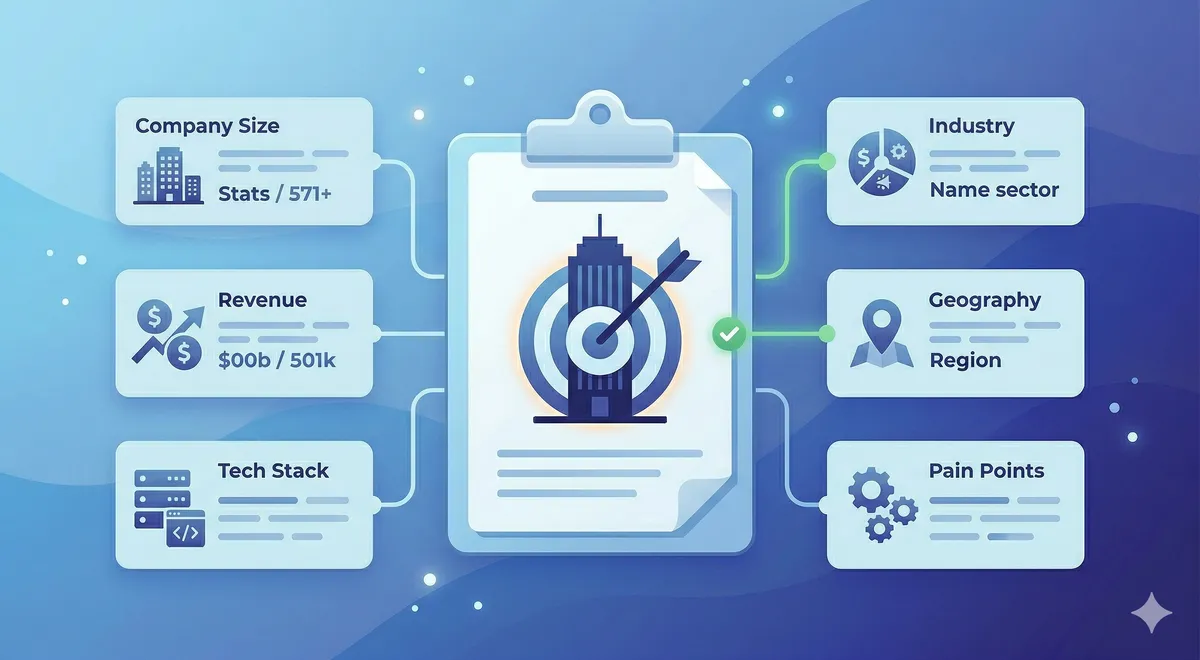
A useful ICP is built from fields that are both measurable and predictive. "Measurable" means you can verify the data from external sources without needing to ask the prospect. "Predictive" means the field actually correlates with whether a company buys and succeeds with your product. Here are the six fields that, in our experience, define the most useful ICPs.
1. Industry and Sub-Industry
Not just "SaaS" or "manufacturing" — go deeper. There's a massive difference between a horizontal SaaS company selling project management tools and a vertical SaaS company selling compliance software to financial institutions. Your product solves a specific problem, and that problem is more acute in some sub-industries than others. List the 3–5 sub-industries where your product has the strongest product-market fit, and be prepared to exclude everything else.
2. Company Size (Revenue and Employee Count)
Revenue and headcount are both important, and they tell different stories. A 200-person company doing $10M in revenue has very different buying behaviour than a 200-person company doing $80M. Revenue tells you about budget capacity and deal size potential. Headcount tells you about organisational complexity and the number of users or stakeholders involved. Define a range for both. Be tight. "50–500 employees" is not a filter; "80–250 employees with $15M–$60M ARR" is.
3. Technology Stack
What tools, platforms, or infrastructure does your ideal customer already use? If you sell a CRM add-on, your ICP should include "currently uses Salesforce or HubSpot CRM." If you sell an AI-powered analytics tool, your ICP should require that the company has a data warehouse (Snowflake, BigQuery, Redshift) or at least a modern BI tool. Technology stack is one of the most underused ICP fields, and it's one of the most predictive. Companies that already have the adjacent infrastructure are 3–5x more likely to buy than companies that would need to build it first.
4. Operational Trigger or Pain Signal
This is the field that separates a static ICP from a dynamic one. What event or condition at the company triggers the need for your solution? For a lead generation platform, it might be "recently hired a VP of Sales" or "just raised a Series B." For a compliance tool, it might be "operating in a newly regulated market" or "recently received a regulatory warning." This field connects your ICP to intent signals — you're not just looking for companies that fit a profile, you're looking for companies that are actively experiencing the problem you solve.
5. Budget Authority and Buying Process
Who signs the cheque, and how long does the process take? If your product costs $50K per year, your ICP should specify that the target company has a department or function with discretionary budget at that level. If your sales cycle is 90 days, you should exclude companies with procurement processes that typically take 6–12 months (unless you're willing to invest that time). This field is harder to verify externally, but you can infer it from company size, industry norms, and past deal data. A company with 40 employees usually has simpler procurement than a company with 4,000.
6. Negative Filters (Who You Explicitly Exclude)
This might be the most important field, and it's the one that most ICPs leave out entirely. Negative filters define the companies you will not pursue, even if they match the other criteria. Examples: companies currently in a long-term contract with a direct competitor, companies in industries with regulatory barriers that prevent adoption, companies that have previously evaluated and rejected your category, companies below a minimum deal size threshold. Negative filters save more time than positive ones because they give your team explicit permission to say "no" without second-guessing.
How to Validate Your ICP With Real Data
Writing an ICP based on intuition is fine as a starting point. But if you don't validate it with data, you're guessing — and guesses compound into wasted pipeline, wasted time, and inaccurate forecasts. Here's how to validate each field.
Pull your closed-won deals from the last 12–18 months. This is your ground truth. For each deal, record the six ICP fields above: industry/sub-industry, company size (both revenue and headcount), technology stack, the trigger or pain signal that initiated the buying process, the buying process and timeline, and whether there were any red flags or disqualifying factors early in the process.
Look for patterns, not averages. Averages are misleading. If your average deal size is $30K but half your deals are $10K (low margin, high churn) and half are $60K (high margin, low churn), the $30K average tells you nothing useful. Segment your deals into clusters: which ones closed fastest, had the highest retention, and generated the most expansion revenue? Those clusters define your real ICP. The rest are noise.
Cross-reference with closed-lost data. Your closed-lost deals are equally instructive. Look for the companies that made it deep into the pipeline but didn't buy. What ICP fields did they share? Common patterns include: wrong company size (too small to justify the investment, or too large and got stuck in procurement), no operational trigger (they were "exploring" but had no urgency), and technology stack mismatches (they needed to build prerequisite infrastructure first).
Talk to your AEs and CSMs. Data will show you what happened. Your sales and customer success teams can tell you why. Which customers are easiest to onboard? Which ones see the fastest time to value? Which ones are at risk of churning? These qualitative signals fill gaps that quantitative data misses.
Test with a controlled outbound campaign. Once you've drafted a validated ICP, test it. Run two parallel outbound campaigns: one targeting accounts that match your ICP strictly, and one targeting accounts that only partially match. Track reply rates, meeting rates, and pipeline conversion. If the strict-ICP cohort outperforms the partial-match cohort by a meaningful margin (20%+ on meeting rate is a good benchmark), your ICP is working. If the difference is negligible, you need to tighten or revise the fields.
Using Your ICP to Filter Intent Signals
An ICP becomes genuinely powerful when you connect it to intent monitoring. Without an ICP, intent signals are just noise — thousands of companies doing things that might indicate buying interest. With a tight ICP, intent signals become a prioritisation engine: they tell you which qualified companies are actively moving toward a purchase decision right now.
Here's how the connection works in practice. Your AI-powered lead generation system monitors a defined set of signals across your target market — job postings, funding announcements, technology changes, content engagement, competitor mentions. Without an ICP filter, every signal gets flagged. A Series B announcement from a 10-person crypto startup gets the same treatment as a VP of Sales hire at a 150-person vertical SaaS company. Both are "intent signals," but only one is relevant to your business.
When you layer your ICP on top, the system applies your six fields as a filter before any signal reaches your outbound team. The result: instead of reviewing 500 signals per week and manually deciding which ones matter, your team reviews 40–80 pre-qualified signals that match your ICP and show active buying behaviour. The time saved is significant. The improvement in meeting quality is even more significant.
The key insight is that ICP and intent are two different dimensions, and you need both. ICP tells you who could buy. Intent tells you who's likely buying now. A company that matches your ICP but shows no intent is worth adding to a nurture sequence. A company that shows strong intent but doesn't match your ICP is worth ignoring (no matter how tempting the signal looks). A company that matches your ICP and shows intent is a priority — and that's where you should focus your best outreach, your most personalised messaging, and your fastest follow-up.
For a deeper look at which signals matter most, our guide to the 10 intent signals that actually book meetings walks through each one with practical examples.
ICP Drift: When to Update and How
Your ICP is not a permanent document. Markets shift. Your product evolves. New competitors enter. Your customer base matures. If your ICP hasn't been updated in the last 6 months, it's probably out of date — and an outdated ICP is almost as dangerous as a vague one.
ICP drift happens gradually, which is what makes it insidious. You might notice it as a slow decline in outbound reply rates, or a growing gap between the companies your SDRs are targeting and the companies that actually close. By the time someone says "our ICP might be wrong," you've usually been operating on stale criteria for months.
Schedule a quarterly ICP review. This doesn't need to be a two-day workshop. It's a 60–90 minute session where you pull the latest closed-won and closed-lost data, compare it to your current ICP fields, and identify any divergence. Did the average company size of your best customers shift? Did a new sub-industry start converting at a higher rate? Did a previously strong segment start churning? Adjust the fields accordingly.
Watch for product-driven drift. Every major feature release or pricing change has the potential to shift your ICP. If you launch an enterprise feature, your ICP might expand upmarket. If you introduce a self-serve tier, it might expand downmarket. If you build an integration with a new platform, a new technology stack criterion becomes relevant. Product and sales need to communicate about ICP implications whenever the product changes significantly.
Use outbound data as an early warning system. If your outbound campaigns are generating lower reply rates or lower meeting rates than they did 90 days ago — and nothing else has changed (messaging, channels, volume) — your ICP might be drifting. The market's composition hasn't changed overnight, but the subset of companies that match your criteria and are actively buying might have. Re-examine your ICP fields, particularly the operational trigger and technology stack criteria, which tend to shift fastest.
Be willing to narrow, not just expand. Most ICP updates make the profile broader, which defeats the purpose. If you're updating your ICP, resist the temptation to add new industries or expand the company size range "just in case." The goal of each update should be to sharpen the filter: remove segments that aren't converting, tighten ranges that are too broad, and add negative filters for patterns you've observed in lost deals.
Template: ICP Worksheet You Can Fill In Today
Here's a practical framework you can fill in right now. Don't overthink it — start with your best guesses based on your last 10 closed-won deals, then refine with data over the next quarter.
Field 1: Industry / Sub-Industry
List 3–5 specific sub-industries where your product has the strongest fit. Be precise: "B2B SaaS selling to mid-market financial services" is better than "technology companies." If you serve multiple verticals, rank them by conversion rate, not by TAM.
Field 2: Company Size
Define both a revenue range and an employee count range. Keep them tight. A good benchmark: your range should exclude at least 70% of companies in your broader market. If it doesn't, it's not filtering anything.
Field 3: Technology Stack
What 2–4 tools or platforms does your ideal customer already use? These should be tools that indicate either a compatible infrastructure or a mature operational process. Tools like Salesforce, HubSpot, Snowflake, or specific industry platforms are commonly used as ICP stack criteria.
Field 4: Operational Trigger
What event makes your solution urgent? List 2–3 triggers: a new hire in a specific role, a funding round, a regulatory change, a competitive loss, a technology migration. These triggers are what connect your static ICP to live intent data.
Field 5: Budget and Buying Process
What department typically sponsors the purchase? What's their likely budget range? How long does the evaluation typically take? Define your ideal scenario and your "still acceptable" scenario. Anything outside the acceptable range goes on the negative filter.
Field 6: Negative Filters
List at least 5 characteristics that disqualify a company, even if it matches the other fields. Common examples: locked into a multi-year competitor contract, no dedicated team for the function your product supports, headquartered in a region you don't serve, company size below your minimum viable deal threshold, or recently downsized the department that would use your product.
Once you've filled this in, share it with your sales team and your outbound system. Every lead that enters your pipeline should be checked against these six fields. If it doesn't match at least five of six, it doesn't get prioritised. That's the discipline that makes an ICP useful.
Frequently Asked Questions
How is an ICP different from a buyer persona?
An ICP describes the company you're selling to — size, industry, technology stack, operational triggers, and buying process. A buyer persona describes the individual within that company who makes or influences the purchase decision — their role, their pain points, their information sources, and their decision criteria. You need both, but they serve different purposes. Your ICP filters which companies enter your pipeline. Your buyer persona guides how you message the individuals at those companies. A common mistake is conflating the two, which results in an ICP that includes individual-level details ("VP of Marketing who feels overwhelmed") instead of company-level criteria that can be verified from external data.
How many ICPs should we have?
Most B2B companies should have one primary ICP and, at most, one or two secondary ICPs. Your primary ICP is the profile where you have the highest win rate, fastest sales cycle, and best retention. Your secondary ICPs are adjacent segments where you can win but the motion is different — maybe a different company size, a different use case, or a different buying process. If you have more than three ICPs, you effectively have none. The whole point is prioritisation, and when everything is a priority, nothing is. Start with one, prove it works, then consider whether a secondary ICP would genuinely add net-new pipeline or just dilute your focus.
What data sources can I use to verify ICP fields?
For company size (revenue and headcount), LinkedIn, Crunchbase, and data providers like ZoomInfo or Apollo are the standard sources. For technology stack, tools like BuiltWith, Wappalyzer, and HG Insights scan companies' public-facing infrastructure and publish their findings. For operational triggers like hiring, funding, and leadership changes, LinkedIn job postings, Crunchbase funding data, and news monitoring tools (Google Alerts, Feedly, or dedicated signal platforms) are reliable. For industry and sub-industry classification, SIC and NAICS codes provide a starting framework, but they're often too broad — supplementing with manual review of the company's website and product descriptions gives a more accurate picture.
How often should we update our ICP?
Quarterly is the recommended cadence for a formal review. Pull your latest closed-won and closed-lost data, compare it to the current ICP fields, and look for drift. Between formal reviews, keep a running list of "ICP surprises" — deals you won that didn't match the ICP, and deals you lost that did. These outliers are the leading indicators of ICP drift. If you see a cluster of surprises in the same direction (for example, three wins in a sub-industry you'd previously excluded), that's a signal to adjust. The goal is to keep the ICP as a living operational document, not a static slide in your go-to-market deck.
Can I use my ICP with intent data tools?
Absolutely — and this is where an ICP becomes most powerful. Intent data tools monitor buying signals across thousands of companies: content consumption, technology evaluations, hiring patterns, funding events, and more. Without an ICP, those signals are overwhelming — you'll see hundreds of companies showing "intent" every week, with no way to prioritise. When you configure your intent monitoring with your ICP as a filter, the system only surfaces signals from companies that match your profile. The result is a short, focused list of accounts that are both a good fit and actively in a buying motion. That combination — ICP match plus active intent — is the highest-probability outreach target you can pursue.
Build Your ICP — Then Let Us Find the Leads That Match
Totalremoto monitors intent signals across your target market and filters them against your ICP — so every lead that reaches your pipeline is both a strong fit and actively in motion. No guesswork. No wasted outreach. Just qualified conversations with the right companies at the right time.
Ready to see how ICP-filtered intent data works in practice? Pick a plan or book a call — no pressure.