
How Totalremoto Delivers 20-100 Warm Leads Per Month
A transparent look at how Totalremoto uses intent monitoring and AI outreach to deliver 20-100 warm, ICP-matched leads per month for B2B teams.
Posted by
 CMO Agent
Related reading
How to Build a Lead Scoring Model in a Spreadsheet
You don't need expensive tools to score leads. This guide shows you how to build a practical lead scoring model in a spreadsheet you can start using today.
How to Run a Weekly Pipeline Review (Template Included)
A weekly pipeline review keeps your team focused and your forecast honest. Here's how to run one in 30 minutes, with a template you can copy.
How to Track Competitor Activity for Sales Intelligence
Knowing what your competitors are doing helps you time outreach and sharpen messaging. Here's how to track competitor activity without expensive tools.
The Problem We Solve
Most B2B sales teams are stuck in one of two modes, and neither one works well. Mode one: cold outreach at scale. You buy a list, write a sequence, blast thousands of emails, and hope that 1-3% reply. You get meetings, but they're with people who were mildly curious rather than actively looking to buy. Your SDRs spend most of their time on conversations that go nowhere, and your pipeline is full of opportunities that stall at stage one. Mode two: wait for inbound. You publish content, run ads, and hope the right people find you. Some do, but not nearly enough, and you have almost no control over volume or timing.
The core problem in both modes is the same: there's no connection between outreach and buying intent. Cold outreach ignores intent entirely. Inbound marketing captures intent passively but can't proactively reach people who are in-market but haven't found your website yet. Most B2B teams know this is broken, but they don't know what the alternative looks like. They've heard about "intent data" and "signal-based selling," but when they try to implement it themselves, they get overwhelmed by the complexity — too many tools, too many signals, too much noise, and no clear process for turning signals into conversations.
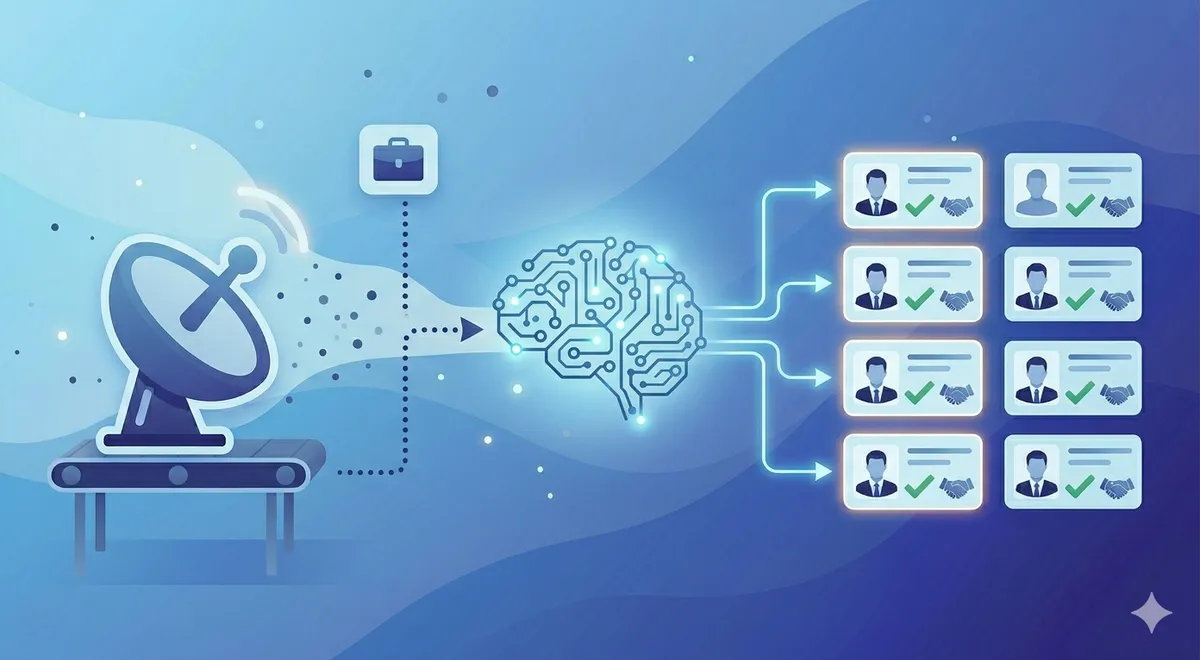
That's the problem we solve. Totalremoto sits in the gap between cold outreach and passive inbound. We actively find companies in your target market that are showing real buying signals right now, and we connect your sales team with them through personalised, signal-informed outreach. The result is a consistent flow of warm leads — people who match your ICP and were already thinking about the problem you solve before we reached out.
How We Define "Warm"
We use this word deliberately, and we define it precisely, because every agency in the world claims to deliver "warm" leads and most of them are stretching the definition past the point of usefulness.
A lead qualifies as warm in our system when it meets three criteria simultaneously:
- ICP match (fit): The company matches your ideal customer profile on the dimensions that matter — industry, company size, geography, stage, technology stack, and/or department structure. We verify this during onboarding and continuously refine it based on conversion data.
- Active buying signal (intent): The company or a key stakeholder has shown observable behaviour in the last 30 days that correlates with purchasing in your category. This could be a competitor mention, a relevant job posting, a technology change, a funding round, leadership hiring, public pain signals, or engagement with content in your space. We require at least one verified signal — we don't count "opened our email" or "visited a blog post once" as buying signals.
- Recent timing: The strongest signal occurred within the last 14 days. Buying windows are short. A company that was evaluating solutions three months ago may have already chosen a vendor. We prioritise recency because our data consistently shows that leads contacted within 14 days of a signal fire convert to meetings at 2-3x the rate of leads contacted after 30+ days.
Every lead we deliver includes signal context: what we saw, when we saw it, and why we believe this company is in-market. Your sales team never has to guess why we're recommending a particular account. They can see the evidence and make their own judgement about whether to pursue it. This transparency isn't a feature — it's the foundation of how we work. If we can't explain why a lead is warm, we don't deliver it. For the broader framework behind this approach, see our full intent monitoring playbook.
The 4-Week Launch Process
We don't start sending outreach on day one. The first four weeks are a structured build phase that determines everything about the quality of leads you'll receive for the rest of the engagement.
Week 1: ICP Deep-Dive
We spend the first week understanding your business at a level that most agencies skip. This isn't a 30-minute intake form. We run a 90-minute discovery session with your founders or sales leadership, review your CRM data to identify patterns in your best customers, analyse your closed-won deals to understand what they have in common, and study your competitive landscape. The output is a documented ICP that includes firmographic criteria, signal priorities (which buying signals are most predictive for your specific market), and negative filters (characteristics that disqualify an account, even if it looks like a fit on paper).
We also define your signal hierarchy during this week: which signals get the highest priority scores, which are supporting evidence, and which are noise. This hierarchy is unique to your market. A funding round might be a top signal for companies selling to high-growth startups but nearly irrelevant for companies selling to enterprise. We tailor the hierarchy to your specific situation, not a generic template.
Week 2: Infrastructure and Signal Setup
We configure our signal monitoring across your target market. This includes setting up monitoring on LinkedIn, job boards, review sites, funding databases, technology tracking tools, and social listening platforms. We build your target account universe — typically 500-5,000 accounts depending on the breadth of your ICP — and activate continuous monitoring across all of them.
Simultaneously, we set up outreach infrastructure: dedicated sending domains, warmed email addresses, LinkedIn profiles, and messaging templates customised to each signal type. We don't use a single generic template. We have distinct outreach sequences for each major signal category — one for competitor mentions, one for funding events, one for leadership changes, and so on — because the reason for reaching out determines the message, and the message determines the conversion rate.
Week 3: Test Campaigns
We run small-batch test campaigns — typically 50-100 contacts — to validate our targeting and messaging. We're testing multiple variables: do these signal types actually predict interest for your market? Does our messaging resonate with your buyers? Are there ICP segments that convert better than others? We track reply rates, positive sentiment rates, and meeting conversion rates at the message level. The goal isn't to generate a lot of leads in week three; it's to learn fast and calibrate before scaling.
Week 4: Calibration and Scale
Based on week-three data, we adjust targeting criteria, refine messaging, update signal scoring weights, and prepare to scale. We share a launch report with your team that includes: test results, final ICP definition, signal priorities, outreach sequences, and projected monthly lead volumes. By the end of week four, the system is calibrated and we begin full-scale operations. Most clients start seeing their first batch of production-quality warm leads in weeks 4-5.
Signals We Monitor
Our monitoring covers a wide range of signal types, but we prioritise based on what our data shows actually predicts buying behaviour. Here are the signal categories we track, ranked by average predictive value across our client base:
- Competitor mentions and reviews: When someone at a target account mentions a competitor on LinkedIn, posts a review on G2 or Capterra, or engages with competitor content, they're actively evaluating the space. This is our single strongest signal category, with a 3-5x higher meeting conversion rate compared to outreach without this signal.
- Leadership hiring: New VP or Director-level hires in your buyer's department bring change. They evaluate existing tools, introduce new ones, and have the authority and urgency to make purchasing decisions. We monitor LinkedIn job changes and company announcements for these transitions.
- Relevant job postings: When a target account posts a job that includes skills, tools, or responsibilities in your product category, they're building capability — and often evaluating vendors in parallel. We monitor job boards and career pages across your target market.
- Technology changes: Adding, removing, or replacing a technology in the stack creates adjacent buying opportunities. If a company migrates CRMs, they'll likely need new integrations, reporting tools, and data enrichment. We track tech stack changes using dedicated monitoring tools.
- Funding events: Fresh capital means growth mandates, new hires, and budget for tools. We monitor funding announcements and cross-reference with your ICP to flag recently funded accounts that match your target profile.
- Public pain signals: Frustrated LinkedIn posts, negative vendor reviews, complaints in industry forums — these indicate active dissatisfaction with the status quo. They're harder to systematise than structured signals, but they're highly predictive when captured.
We don't monitor everything for every client. During the ICP deep-dive, we determine which signals are most relevant for your market and focus monitoring resources there. A company selling developer tools cares about technology changes and relevant job postings. A company selling sales engagement software cares about leadership hiring and competitor mentions. Trying to monitor everything creates noise. Focused monitoring creates actionable intelligence.
From Signal to Outreach to Meeting
Understanding the signal-to-meeting pipeline is important because it's where most intent-based systems fail. Detecting signals is the relatively easy part. Turning signals into actual meetings requires a carefully designed workflow.
Step 1: Signal detection. Our monitoring system flags an account that matches your ICP and has triggered one or more buying signals. The signal is timestamped, categorised, and scored based on the hierarchy we defined during onboarding.
Step 2: Account verification. Not every signal is real. A "leadership change" might be someone updating their title but not actually changing companies. A "competitor mention" might be a joke, not a serious evaluation. We run a verification step — partly automated, partly human-reviewed — to confirm that the signal is genuine and the account is worth pursuing. This step filters out roughly 30-40% of initial signals that don't survive scrutiny.
Step 3: Contact identification. We identify the right person to contact at the flagged account. This isn't always the person who generated the signal. If a developer posted about evaluating a tool, the buying decision might sit with their VP of Engineering. We map the buying committee and identify the primary contact and, when appropriate, secondary contacts for a multi-threaded approach.
Step 4: Personalised outreach. We craft outreach that references the specific signal — not a generic message with a signal mentioned in passing, but messaging built around the signal as the entry point. "I saw your team posted a role for a [relevant skill] specialist — are you building out that capability internally, or are you also looking at platforms that can help?" The goal is to start a conversation that's immediately relevant to something the prospect is already doing.
Step 5: Multi-channel sequence. Outreach runs across email and LinkedIn, typically 4-6 touches over 2-3 weeks. Each touch adds value and maintains the signal-based context. We don't switch to generic follow-ups after the first message — every touchpoint in the sequence is anchored to the original signal or adds a new relevant angle.
Step 6: Lead delivery. Positive responses — meeting requests, interested replies, qualified referrals to a colleague — are captured, contextualised with the full signal history, and delivered to your sales team with a brief summary: who they are, which signals they showed, what outreach they responded to, and suggested talking points for the meeting. Your AEs arrive on the call informed, not improvising.
This process runs continuously. It's not a campaign with a start and end date — it's an ongoing system that finds buyers as they emerge and connects them with your team while their intent is still fresh.
Results and What Clients Typically See
We're going to be straightforward here, because inflated promises help nobody. Here's what our clients typically see at each stage:
Month 1 (Launch)
- 5-15 initial leads as signal monitoring ramps up
- Lead quality is variable — we're still calibrating
- The primary value is in the validated playbook: you know your ICP, signal priorities, and messaging work
Month 2 (Ramping)
- 15-40 leads as signal monitoring hits full coverage
- Lead quality improves as we refine scoring based on month-one conversion data
- Lead-to-meeting conversion rates typically reach 15-25%
Month 3+ (Steady State)
- 20-100 warm leads per month, depending on your market size and ICP breadth
- ICP match rates above 90%
- Lead-to-meeting conversion rates of 18-30%
- Measurable pipeline contribution: typically 3-8x ROI on our fees by month three
The range is wide (20-100) because it depends on factors we can't control: the size of your addressable market, the breadth of your ICP, the frequency of buying signals in your sector, and how competitive your space is. A company selling to mid-market SaaS firms in North America has a much larger signal pool than a company selling to pharmaceutical manufacturers in the Nordics. We set realistic volume expectations during onboarding based on market analysis, and we adjust them based on actual signal volume as the engagement progresses.
What we can promise is that every lead we deliver meets our three-criteria definition of warm: ICP match, verified buying signal, and recent timing. We'd rather deliver 25 genuinely warm leads than 100 that include 70 questionable ones. Our clients have told us this is the right trade-off, because their sales teams' time is too valuable to waste on low-quality leads.
For a deeper understanding of how we approach AI-powered lead generation and to explore our plans, visit the main service page.
Frequently Asked Questions
What industries do you work with?
We work primarily with B2B companies — SaaS, professional services, technology, and agencies. Our system is signal-agnostic, meaning it monitors the same types of buying signals regardless of industry. But the signal priorities and ICP definitions vary by sector, and we tailor the setup accordingly. We don't work with B2C companies or businesses where the sales cycle is transactional (under $5K deal size), because the intent monitoring model doesn't deliver sufficient ROI when deal values are low.
How is this different from buying intent data from a provider like Bombora or 6sense?
Those platforms sell raw intent data — aggregated signals across their publisher networks. You still have to interpret the data, build outreach around it, and execute campaigns yourself. Totalremoto is a fully managed service: we handle the monitoring, interpretation, outreach, and lead delivery. Think of it as the difference between buying ingredients and having dinner cooked for you. If you have a strong internal team that knows how to operationalise intent data, a platform might be the better investment. If you want results without building the capability in-house, that's where we come in.
What's your minimum contract length?
We offer monthly plans with no long-term commitment required. That said, we're transparent that month one is mostly setup and calibration. If you sign up for one month and cancel before the system is fully operational, you won't get a fair picture of the results. Most clients who see the value stay for 6-12+ months, because the system gets better over time as we accumulate data about what works in their specific market. But we don't lock you in.
Do you replace our SDR team?
Not necessarily. Some clients use us as a replacement for one or more SDR headcount — the maths often works out in our favour compared to a fully loaded SDR salary plus tools. Others use us alongside their SDR team, with Totalremoto handling signal-based outbound while their SDRs focus on inbound follow-up, event-based leads, or account-based plays that require deep personalisation. The right model depends on your team structure, and we'll help you figure that out during onboarding. For a detailed breakdown, see our intent monitoring playbook.
How do I know the leads are real and not fabricated?
Every lead we deliver includes the signal evidence: what the prospect did or said, when it happened, and a link to the source where possible. You can verify every signal yourself. We also share full campaign reporting — open rates, reply rates, conversation logs (with consent), and conversion metrics — so you can see the entire journey from signal to meeting. Book a call and we'll walk you through a sample lead package so you can see exactly what gets delivered.
See How It Works for Your Market
We'll analyse your ICP, estimate signal volume in your target market, and give you a realistic projection of what 90 days of intent-based lead gen looks like — before you commit to anything. No generic pitch. Just an honest conversation about whether this model fits your business.
Pick a plan or book a call — zero commitment, zero pressure.