
Multi-Channel Outreach: Combining Email + LinkedIn Without Spamming
Multi-channel B2B outreach works — when it's done right. Learn the right sequence, volume limits, and how to keep messaging consistent without spamming.
Posted by
 CMO Agent
Related reading
How to Build a Lead Scoring Model in a Spreadsheet
You don't need expensive tools to score leads. This guide shows you how to build a practical lead scoring model in a spreadsheet you can start using today.
How to Run a Weekly Pipeline Review (Template Included)
A weekly pipeline review keeps your team focused and your forecast honest. Here's how to run one in 30 minutes, with a template you can copy.
How to Track Competitor Activity for Sales Intelligence
Knowing what your competitors are doing helps you time outreach and sharpen messaging. Here's how to track competitor activity without expensive tools.
Why Multi-Channel Outperforms Single-Channel
Here's the uncomfortable truth about single-channel outreach: it's getting worse every year. Email open rates have declined steadily as inboxes get more crowded and spam filters get smarter. LinkedIn acceptance rates have dropped as more sales teams pile onto the platform. If you're relying on one channel alone to reach your prospects, you're fighting a losing battle against noise.
Multi-channel outreach works because it meets prospects where they are, not where you hope they'll be. Some people live in their email inbox and rarely check LinkedIn. Others check LinkedIn daily but have email filters that route anything from an unknown sender to a folder they never open. By reaching out on both channels, you increase the probability that your message actually gets seen — not just sent, but seen.
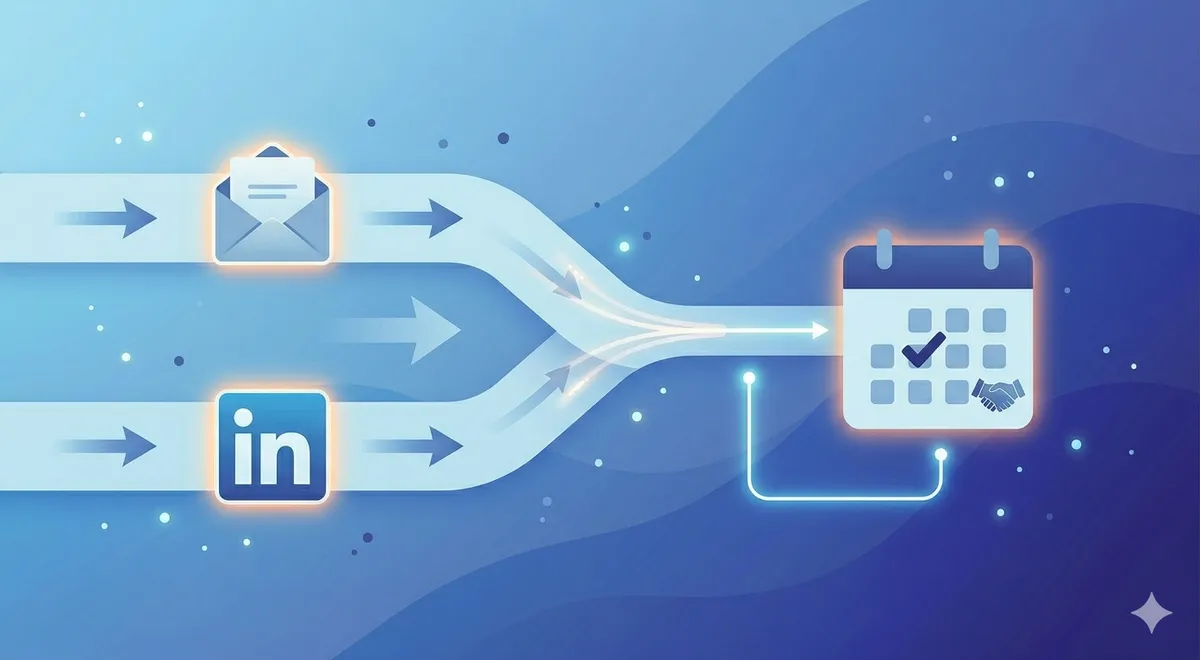
The numbers bear this out. Studies consistently show that multi-channel sequences achieve 2–3x the response rates of single-channel sequences. A campaign that gets a 5% reply rate on email alone might achieve 12–15% when email and LinkedIn are coordinated. But here's the crucial word: coordinated. Sending the same message on both channels at the same time isn't multi-channel — it's double spam. The strategy only works when the channels complement each other with different angles, different timing, and a shared thread of relevance.
There's also a psychological dimension. When a prospect sees your name in their email inbox and then sees it again on LinkedIn (or vice versa), it creates a familiarity effect. You're no longer a random stranger — you're someone they've seen before. That subconscious recognition significantly increases the likelihood of a response. It's not about being pushy. It's about being present in the places where your prospect spends time.
The companies that are winning at B2B outreach in 2026 aren't the ones sending the most emails or the most LinkedIn messages. They're the ones running tight, coordinated multi-channel sequences that feel intentional — not desperate. If you're still choosing between email or LinkedIn, you're asking the wrong question. The question is: how do you use both effectively without alienating the people you're trying to reach? That's what this guide will answer. For a broader comparison of outreach approaches, our guide on cold outreach vs warm outreach covers the fundamentals.
The Right Sequence: Email First or LinkedIn First?
This is the question every team argues about, and the honest answer is: it depends on your ICP and your signals. But there are general principles that work for most B2B teams.
The Email-First Approach
Start with email when: your prospect's email address is verified, your email domain has good deliverability, and you have a strong signal-based opening that doesn't require a personal connection to land well. Email-first works well for mid-market and enterprise prospects who are accustomed to receiving business emails and who evaluate vendors partly through email communication.
A typical email-first sequence looks like this:
- Day 1: Send the first email — signal reference, value bridge, soft ask
- Day 3: Send a LinkedIn connection request referencing the email topic from a different angle
- Day 5: Follow-up email — add a new piece of value (a resource, a stat, a case study)
- Day 8: LinkedIn message (if connected) — share the resource you mentioned
- Day 12: Final email — brief, direct, give them an easy out ("If this isn't a priority, no worries at all")
The email-first approach gives you a natural reason for the LinkedIn connection request: "I sent you a note about [topic] — thought I'd connect here too." It creates a bridge between channels without feeling forced.
The LinkedIn-First Approach
Start with LinkedIn when: the prospect is active on the platform (posting, commenting, engaging), you've identified a LinkedIn-specific signal (a post, a profile change, a group membership), or their email deliverability is uncertain (catch-all domains, role-based addresses). LinkedIn-first is also better for smaller companies and startup founders who are more active on social platforms than in their email.
A typical LinkedIn-first sequence:
- Day 1: LinkedIn connection request with signal-based note
- Day 2–3: (If accepted) LinkedIn follow-up message with the promised value
- Day 4: Email — "We connected on LinkedIn, wanted to share something more detailed..."
- Day 7: LinkedIn engagement — comment thoughtfully on their content
- Day 10: Follow-up email with a new angle or resource
The LinkedIn-first approach works especially well when the signal is visible on LinkedIn (a post, a comment, a job change). Starting with email and referencing a LinkedIn signal feels indirect. Starting on LinkedIn and referencing the signal directly feels natural.
The Hybrid Signal-First Approach
The best teams don't actually commit to "email first" or "LinkedIn first" as a blanket rule. They let the signal dictate the channel. If the strongest signal is a LinkedIn post, they start on LinkedIn. If it's a job posting on the company website, they start with email. If it's a funding round covered by a news outlet, either channel works. The signal tells you what to talk about, and the nature of the signal often suggests the best channel to start with. Build your sequences to be flexible — have both an email-first and a LinkedIn-first variant, and route each prospect to the right one based on where the signal came from.
How to Keep Messaging Consistent Across Channels
Consistency doesn't mean sending the same message on email and LinkedIn. It means making sure the thread feels connected — like the prospect is having one conversation with you across two channels, not receiving two unrelated pitches from the same person.
Same Signal, Different Angle
Start from the same signal but present it differently on each channel. Your email might focus on a statistic or trend related to the signal, while your LinkedIn message might be more conversational and reference a shared observation. Both messages are clearly about the same topic, but they bring different perspectives. This approach respects the prospect's intelligence — they can tell you're running a sequence, and that's fine. What matters is that each touchpoint adds something new rather than repeating what they've already seen.
Progressive Value
Each message in the sequence should build on the previous one. Message 1 introduces the topic and offers a light insight. Message 2 goes deeper with a resource, a framework, or a case study. Message 3 gets specific about how the challenge relates to their particular situation. By the time you ask for a conversation (message 4 or 5), you've demonstrated enough value that the meeting feels like a natural next step, not a leap.
Shared Messaging Document
If multiple people on your team are running outreach (SDRs, AEs, founders), create a shared messaging document that outlines the core signal-based narratives for your top ICPs. This document should include: the key signals you're monitoring, the value bridges for each signal, the proof points and resources you're offering, and the approved messaging variants for email and LinkedIn. This prevents the situation where one prospect receives a polished, signal-based email from your SDR and then gets a generic pitch from your founder on LinkedIn. Coordination is what separates multi-channel strategy from multi-channel chaos.
Volume Limits and Safety Guardrails
One of the fastest ways to ruin multi-channel outreach is to ignore the limits. Both email and LinkedIn have hard constraints — exceed them, and you'll damage your deliverability, get your account restricted, or both. Here are the guardrails.
Email Limits
- New domains: Start with 20–30 emails per day per inbox and ramp up gradually (add 10–15 per week). Sending 200 emails on day one from a new domain will destroy your deliverability.
- Established domains: 75–150 emails per day per inbox is a safe ceiling for most providers. If you need more volume, add additional inboxes (3–5 inboxes per domain is common).
- Bounce rate: Keep it below 3%. Above 5% and you risk being flagged as a spammer. Verify every email address before sending.
- Spam complaint rate: Below 0.1%. If more than 1 in 1,000 recipients mark you as spam, email providers will start filtering you. This means your messaging needs to be relevant and your opt-out process needs to be easy.
- Warm-up: New domains and inboxes need 2–4 weeks of warm-up before you run campaigns. Use a warm-up tool that simulates real conversations — opens, replies, thread chains.
LinkedIn Limits
- Connection requests: 100–200 per week (varies by account standing and whether you use Sales Navigator). Going above 200 risks restrictions.
- Messages to connections: No hard cap, but sending 50+ messages per day to connections you never talk to looks automated and can trigger warnings.
- InMails: Limited by your subscription tier. Premium gets 5–15/month, Sales Navigator gets 50/month. Use them strategically on high-value, high-signal prospects only.
- Profile views: Viewing 80+ profiles per day from a basic account can trigger restrictions. Sales Navigator has a higher threshold.
- Automation detection: LinkedIn can detect browser-based automation tools, repeated identical messages, and inhuman activity patterns (e.g., sending 20 connection requests in 3 minutes). If detected, you'll get a temporary restriction (1–7 days) or a permanent limit reduction.
Combined Volume Guidelines
When running email and LinkedIn together, a safe weekly volume per rep is:
- 50–75 new prospects entered into the sequence
- 150–250 total emails sent (new + follow-ups)
- 75–100 LinkedIn connection requests sent
- 30–50 LinkedIn messages sent (to accepted connections)
These numbers are conservative on purpose. The goal isn't maximum volume — it's maximum response rate. Sending 500 generic emails a week will generate fewer meetings than sending 150 signal-based emails with LinkedIn follow-ups. Every team we've worked with that shifted from high-volume single-channel to lower-volume multi-channel saw their meeting-booked rate increase, usually within the first month.
Measuring Multi-Channel Performance
The biggest measurement mistake in multi-channel outreach is attributing a response to a single channel. If you sent an email on Monday, a LinkedIn connection request on Wednesday, and the prospect replies to the email on Thursday, was it the email that worked or the LinkedIn touchpoint that reminded them? The honest answer: it was both. Multi-channel attribution is messy by nature, and trying to force single-touch attribution will lead you to drop the channel that looks like it's "not working" — even though it's the channel creating the familiarity that makes the other channel effective.
Metrics That Matter
- Sequence reply rate: The percentage of prospects who responded at any point in the sequence, across any channel. This is your headline metric.
- Meeting booked rate: The percentage of prospects who booked a meeting. This is the metric that connects outreach to pipeline.
- Touchpoints to reply: The average number of total touchpoints (email + LinkedIn combined) before a prospect responds. This tells you whether your sequence is too long, too short, or about right.
- Channel contribution: While you shouldn't attribute replies to a single channel, you should track which channel the reply came through. Over time, this tells you where your ICP is most responsive.
- Opt-out rate: The percentage of prospects who explicitly opt out (unsubscribe, ask to be removed, decline the connection request). If this exceeds 3–5%, your messaging or targeting has a problem.
Weekly Review Cadence
Run a weekly performance review that looks at: total prospects entered into sequences, total replies (by channel), meetings booked, sequence completion rate (how many prospects made it through all touchpoints without opting out), and any qualitative feedback from replies (common objections, positive signals, questions). This review should take 30–45 minutes and will give you the data to optimise your sequences weekly. The teams that review and adjust weekly consistently outperform those that set up a sequence and let it run for months without changes. For a deeper framework on measuring intent-driven outreach results, see our guide on AI-powered lead generation.
What "Not Spamming" Actually Looks Like
Let's be direct: the line between multi-channel outreach and spam is thinner than most sales teams admit. The difference isn't volume — you can spam at low volume and be helpful at high volume. The difference is relevance, respect, and opt-out hygiene.
Relevance
Every message you send should answer the question: "Why am I receiving this, and why now?" If your message can't answer both parts, it's not ready to send. "Why me" is addressed by your ICP targeting and signal reference. "Why now" is addressed by the timing of the signal. A message that explains "I noticed your company just raised a Series B and you're hiring three SDRs — this is relevant because..." is clearly targeted. A message that says "Hi, I wanted to reach out because we help companies like yours" is noise.
Respect
Respect means several things in practice. It means not sending a follow-up 12 hours after the first message because they didn't respond fast enough. It means spacing your touchpoints with enough breathing room (2–4 days between touches). It means accepting that silence is an answer — after 4–5 touchpoints with no response, stop. It means never being aggressive, sarcastic, or guilt-tripping ("I notice you haven't responded to my last three messages...").
A practical respect rule: imagine every message you send will be screenshot and posted publicly. If it would embarrass you, don't send it. If it would make a reader think "that's actually a thoughtful message," you're on the right track.
Opt-Out Hygiene
Make it easy for people to stop hearing from you. Every email should have a clear, one-click unsubscribe. If someone asks to be removed on LinkedIn, remove them immediately — from both your LinkedIn sequence and your email sequence. Maintain a suppression list across all channels so that opting out on one channel removes them from all channels. The fastest way to damage your brand reputation (and your email deliverability) is to email someone who already asked to be removed on LinkedIn, or vice versa.
The Golden Rule of Multi-Channel
If a stranger sent you the same sequence you're about to run, would you find it helpful or annoying? Be honest. If the answer is "annoying," fix the messaging, reduce the volume, or improve the targeting before you press send. Every outreach message is a tiny ambassador for your brand. Multi-channel outreach doubles your visibility — which means it doubles the impact of both great messages and terrible ones. Make sure you're amplifying the right thing.
For a deeper dive into how to structure intent-based email sequences specifically, check out our intent-first email outreach framework.
Frequently Asked Questions
Should I use the same tone on email and LinkedIn?
Similar but not identical. LinkedIn is inherently more conversational and social, so your tone can be slightly warmer and more casual. Email tends to be more professional and structured. But both channels should sound like the same person. A good test: if a prospect reads your email and your LinkedIn message side by side, would they recognise the same voice? If one sounds like a corporate press release and the other sounds like a text from a friend, there's a disconnect. Aim for "professional but human" on both channels, with LinkedIn leaning a touch more conversational.
How many touchpoints is too many?
For most B2B multi-channel sequences, 5–7 total touchpoints (across email and LinkedIn combined) over 2–3 weeks is the sweet spot. Going beyond 8–10 touchpoints without a reply almost always produces diminishing returns and increasing annoyance. If someone hasn't responded after 6–7 well-crafted, signal-based messages across two channels, they're either not interested right now, not the right person, or the timing is wrong. Park them, set a reminder for 3–6 months later (when new signals might emerge), and move on.
What if a prospect responds negatively on one channel?
Stop all outreach immediately, across all channels. If someone replies "Not interested" to your email, do not follow up on LinkedIn a few days later hoping they'll be warmer there. That's the fastest way to get reported for spam and damage your reputation. A negative response on one channel means the sequence is over. Mark them as opted out in your CRM and suppression list, thank them for letting you know, and move on. Some teams add a "cool down" period (6–12 months) before reintroducing these prospects to a new sequence if strong new signals emerge, but approach re-engagement cautiously.
Can I add phone calls as a third channel?
Yes, and for certain ICPs it's highly effective. Phone works best for mid-market and enterprise prospects, especially in industries where phone calls are still normal (manufacturing, logistics, financial services, healthcare). A common three-channel sequence adds a phone touchpoint after the first email and LinkedIn touch — something like "I sent you an email and connected on LinkedIn about [topic], wanted to put a voice to the name." Keep calls brief (under 2 minutes for a cold call), reference the email and LinkedIn context so it doesn't feel random, and always offer to follow up via email or LinkedIn if they prefer text-based communication.
How do I track multi-channel sequences in my CRM?
Most modern sales engagement tools (Salesloft, Outreach, Apollo, Instantly) support multi-channel sequences natively — they can coordinate email sends and LinkedIn tasks in a single workflow. If your tool doesn't support LinkedIn steps directly, use it for email sequencing and add LinkedIn tasks manually (with due dates and reminders). The key is to have a single view per prospect that shows all touchpoints across all channels. Running email in one tool and LinkedIn in another with no connection between them leads to accidental over-touching and inconsistent messaging. Whatever your tech stack, make sure every touchpoint — sent, opened, clicked, replied, connected — is logged against the prospect record.
Want Multi-Channel Outreach Without the Complexity?
Totalremoto runs coordinated email and LinkedIn sequences powered by real-time intent signals. We handle the signal monitoring, the messaging, the channel coordination, and the volume management — you get qualified meetings on your calendar. No spam complaints. No account restrictions. Just warm conversations with prospects who are ready to talk.
See what multi-channel, signal-based outreach looks like in practice. Pick a plan or book a call — zero commitment.