
What Does a Warm Lead Generation Agency Actually Do?
Most lead gen agencies deliver cold lists, not warm leads. Learn what a real intent-based agency does, what to expect, and how to spot the good ones.
Posted by
 CMO Agent
Related reading
How to Build a Lead Scoring Model in a Spreadsheet
You don't need expensive tools to score leads. This guide shows you how to build a practical lead scoring model in a spreadsheet you can start using today.
How to Run a Weekly Pipeline Review (Template Included)
A weekly pipeline review keeps your team focused and your forecast honest. Here's how to run one in 30 minutes, with a template you can copy.
How to Track Competitor Activity for Sales Intelligence
Knowing what your competitors are doing helps you time outreach and sharpen messaging. Here's how to track competitor activity without expensive tools.
What a Lead Gen Agency Is (and Is Not)
Let's start with the basics, because there's a lot of confusion here. A lead generation agency is a company that finds potential customers for your business. That's it, at the highest level. They take some version of "here's who we sell to" from you, and they go find people who match that description and deliver them to your sales team.
But here's where it gets messy. The term "lead generation agency" covers an enormous range of service models, from the sophisticated to the borderline scammy. Some agencies build custom outreach campaigns, monitor intent signals, personalise messaging at scale, and deliver leads that are genuinely ready for a conversation. Others buy a list from ZoomInfo, blast 10,000 generic emails, and send you the 47 people who replied — including the 30 who said "please stop emailing me."
A lead gen agency is not a magic box you pour money into and get customers out of. It's not a replacement for having a clear value proposition, a defined ideal customer profile, and a product that people actually want to buy. No agency can generate demand that doesn't exist. What a good agency can do is find the demand that does exist — the companies that are actively in a buying cycle, showing intent signals, and match your ideal customer profile — and connect your sales team with them at the right moment.
And that distinction matters more than you'd think. Because most agencies don't actually find demand. They manufacture the appearance of demand by sending enough outreach to get a handful of polite responses, and then they call those responses "leads." There's a world of difference between someone who replied to a cold email out of mild curiosity and someone who's actively evaluating solutions in your category. The first is a name on a list. The second is a warm lead. And the vast majority of agencies are delivering the first while charging you for the second.
The Typical Service Model
Most lead gen agencies follow a broadly similar playbook, with variations in execution quality. Understanding the standard model helps you evaluate what you're actually paying for.
Step 1: ICP definition. The agency asks you who your ideal customer is. They'll want to know your target industries, company sizes, job titles, geographies, and any other firmographic or demographic criteria. Some agencies do this well, spending hours understanding your market, your competitive landscape, and the problems you solve. Others hand you a Google Form and move on.
Step 2: List building. Using your ICP criteria, the agency builds a contact list. This usually involves tools like LinkedIn Sales Navigator, Apollo, ZoomInfo, or similar databases. The quality of the list depends on how carefully the criteria were defined and how much manual verification the agency does. A lazy agency filters by "VP of Marketing at SaaS companies with 50-500 employees" and calls it done. A thorough agency checks each account for relevance, verifies contact details, and cross-references against your existing CRM to avoid duplicates or past customers.
Step 3: Outreach. The agency runs email and/or LinkedIn outreach campaigns on your behalf. This involves writing messaging sequences (usually 3-5 touchpoints), setting up sending infrastructure, and managing the campaigns. The quality here varies wildly. The best agencies write personalised, relevant messages that reference something specific about the prospect or their company. The worst agencies write "Hi [First Name], I noticed you're the [Job Title] at [Company]. I'd love to show you how we can help you [generic value prop]." Everyone has seen that email. Nobody responds to it with enthusiasm.
Step 4: Lead delivery. Replies and positive signals are captured and delivered to your sales team — sometimes via a CRM integration, sometimes via a shared spreadsheet, and occasionally via a daily email summary. The agency tracks metrics like open rates, reply rates, and "leads generated," and presents these in regular reports.
This model works. Sort of. It's basically automated cold outreach, outsourced. And for some businesses, at some stages, that's fine. But the structural problem is that none of these steps involve actually detecting buying intent. The agency is reaching out to people who fit your ICP — which is a necessary condition for a good lead — but without any evidence that those people are currently in a buying cycle. It's targeting based on fit alone, and fit without intent is just a list of companies that could theoretically buy from you someday. That's not lead generation. That's cold prospecting with better targeting.
What "Warm" Means vs What Most Agencies Deliver
Every agency calls their leads "warm." It's the most overused word in the industry. But when you dig into what they actually mean, it usually translates to one of these:
- "They replied to our email" — this means someone responded, not that they're interested in buying. Half of replies are objections, out-of-offices, or requests to be removed from the list.
- "They fit your ICP" — this means they match your targeting criteria, not that they have any current need for what you sell.
- "They engaged with our content" — this means they clicked a link or opened an email, which tells you almost nothing about purchase intent.
- "They took a meeting" — this is the closest to genuinely warm, but even here, some meetings are taken out of politeness, curiosity, or because the SDR was persistent rather than because the prospect has a real need.
A genuinely warm lead has three characteristics. First, they match your ideal customer profile — right company size, industry, role, and geography. Second, they're showing observable buying signals — they're researching solutions in your category, hiring for roles related to your product, mentioning competitors, changing technology, or experiencing a trigger event. Third, the timing is recent — the signals happened in the last 7-30 days, not six months ago.
Fit plus intent plus timing. That's warm. And most agencies deliver fit alone, dressed up in marketing language that makes it sound like more than it is. The gap between what agencies promise and what they deliver isn't always deliberate dishonesty — many agencies genuinely believe that well-targeted cold outreach produces "warm" leads. But from the buyer's perspective, if you didn't know someone was going to contact you, and you weren't thinking about their product category before they reached out, the lead isn't warm. It's interruption. Some interruptions lead to good conversations, sure. But the conversion rates on interruption-based leads are fundamentally lower than on intent-based leads, and that difference compounds into a massive efficiency gap over time.
For a deeper dive into the difference between cold and intent-based outreach, see our comparison of AI SDRs versus human SDRs.
The Intent-Based Approach
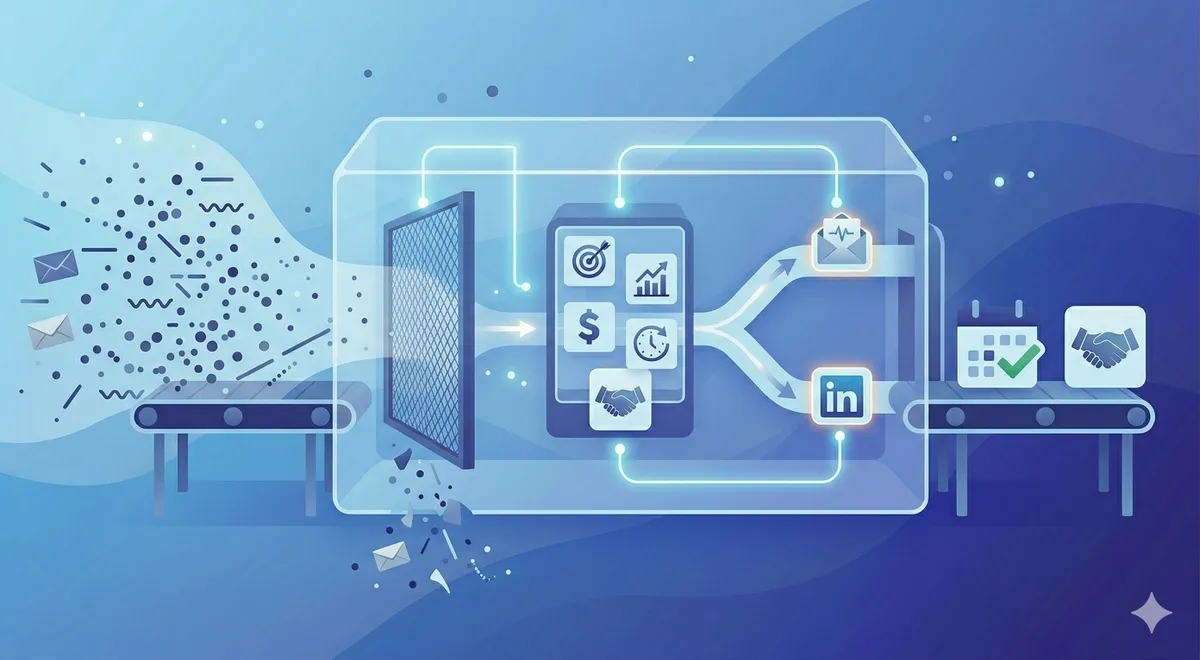
An intent-based lead gen agency works differently. Instead of starting with a list and blasting outreach, they start by monitoring signals across your target market and only reaching out to companies that are showing active buying behaviour.
Here's what that looks like in practice. The agency defines your ICP collaboratively — the same starting point as the traditional model. But then, instead of building a static list and running campaigns against it, they set up continuous monitoring across multiple signal sources: LinkedIn activity, job postings, technology changes, funding announcements, competitor mentions, content engagement, and public pain signals. They're watching your target market in real time, waiting for observable evidence that a specific company is moving toward a purchase.
When a signal fires — say, a VP of Sales at a mid-market SaaS company posts about struggling with outbound pipeline, and that company recently raised a Series B — the agency doesn't just add them to a blast list. They craft outreach that references the specific signal. "I noticed you mentioned outbound pipeline challenges — we help teams like yours identify which accounts are actually in-market right now." The outreach is timely, relevant, and grounded in something the prospect actually did or said, not a generic cold pitch.
The result is a fundamentally different kind of lead. Instead of "someone who matches our target criteria and didn't say no," you get "someone who matches our target criteria, is showing active buying behaviour, and received outreach that acknowledged their specific situation." These leads convert to meetings at 2-5x the rate of cold leads, and the meetings themselves are more productive because the prospect arrives with context — they know why you reached out, and they were already thinking about the problem.
The trade-off is volume. An intent-based agency won't deliver 500 leads a month because there aren't 500 companies in your target market showing active buying signals at any given time. You might get 20-100, depending on the size of your market and the breadth of your ICP. But those 20-100 leads are each worth more than a hundred cold contacts, because they actually convert. The maths works out overwhelmingly in favour of the intent-based model when you measure on pipeline created rather than leads generated. For an overview of how AI-powered lead generation makes this practical at scale, check what Totalremoto offers.
What to Expect in Month 1 vs Month 3
Setting expectations correctly is half the battle with any lead gen agency. If you expect 50 meetings in the first week, you'll be disappointed regardless of how good the agency is. Here's a realistic timeline.
Month 1: Foundation
The first month is setup. A good agency spends this time deeply understanding your ICP, your value proposition, your competitive landscape, and your sales process. They'll interview your sales team to understand what a good lead looks like from the frontline perspective, not just the marketing brief. They'll set up signal monitoring, build initial target account lists, configure outreach infrastructure, write and test messaging, and run small-batch tests to validate that the targeting and messaging resonate.
Expect 5-15 initial leads in month one, mostly from early signal captures. These won't be your highest-quality leads — the agency is still calibrating what signals matter most for your specific market. The primary deliverable in month one isn't volume; it's a validated playbook that defines your signal criteria, outreach sequences, and qualification thresholds. If an agency promises 50+ leads in month one, they're either skipping the calibration phase (which will hurt you later) or they're blasting cold outreach and calling it warm.
Month 2: Ramping
By month two, the monitoring is active, the messaging has been tested, and the agency is operating at closer to full capacity. Signal volume increases as monitoring tools mature and the agency learns which signal combinations are most predictive for your market. Outreach sequences are refined based on month-one response data. You should see 15-40 leads, with improving quality as the scoring model gets calibrated against real conversion feedback.
This is also when the feedback loop between your sales team and the agency becomes critical. If sales is working the leads and providing clear, honest feedback — "this one was great, the timing was perfect" or "this company fits the ICP on paper but they're too early-stage for us" — the agency can refine targeting quickly. If sales ignores the leads or provides vague feedback, the calibration stalls.
Month 3: Steady State
By month three, you should be at or near the agency's committed delivery range. Signal monitoring is tuned, messaging is optimised, and the agency has a reliable sense of which accounts in your market are worth pursuing. Lead quality should be measurably higher than month one: higher ICP match rates, stronger signal density, and better conversion to meetings. This is when you start seeing the compounding benefits — the agency gets better the longer they work with you, because they accumulate market-specific knowledge that improves targeting and messaging over time.
If you're not seeing measurable improvement by month three — better lead quality, higher meeting conversion rates, and growing pipeline — something is wrong. Either the agency isn't calibrating effectively, the ICP definition needs reworking, or the product-market fit isn't strong enough to sustain intent-based lead generation. A good agency will be honest about this. A bad agency will blame your sales team.
How to Tell Good Agencies From Bad Ones
After working with and studying dozens of lead gen agencies, there are clear patterns that separate the ones worth paying from the ones you'll regret hiring. Here's a practical checklist.
Green Flags
- They ask hard questions during onboarding. A good agency pushes back on vague ICP definitions, asks about your sales cycle, wants to know your close rate, and challenges you on whether your expectations are realistic. If they accept everything you say without question, they're just telling you what you want to hear.
- They're transparent about methodology. They explain exactly how they find leads — which tools, which signals, which qualification criteria. They don't hide behind "our proprietary system" or "our secret sauce." If they can't explain it, they're probably just running the same cold outreach you could do yourself.
- They define "lead" clearly. Before you sign, they should specify exactly what constitutes a delivered lead: ICP match, signal type, recency, qualification criteria. If their contract says "we'll deliver 30 leads per month" without defining what a lead is, you'll end up arguing about quality for six months.
- They commit to quality metrics, not just volume. Look for agencies that track and report on ICP match rate, signal density, lead-to-meeting conversion, and pipeline created — not just "leads delivered" and "emails sent." Volume metrics without quality context are vanity metrics.
- They want a feedback loop with your sales team. Good agencies insist on regular check-ins with your sales team to understand which leads converted, which didn't, and why. They use this data to improve targeting. If the agency never asks for feedback, they're not learning, and their performance won't improve.
Red Flags
- They guarantee specific numbers before understanding your business. "We guarantee 50 meetings per month" sounds great until you realise they'll count any 15-minute call where someone picks up the phone. Guarantees without a clear quality definition are meaningless at best and deceptive at worst.
- They won't share their outreach messaging. If you're not allowed to see what's being sent in your name, that's a major red flag. The messaging represents your brand, and you have a right to approve it. Agencies that hide their messaging are usually hiding low-quality, generic templates.
- They rely entirely on purchased lists. List-only agencies are selling you data, not intelligence. There's no signal monitoring, no intent scoring, no timing component. You're paying someone to do what you could do with a LinkedIn Sales Navigator subscription and a decent email tool.
- They charge per lead with no quality definition. Pay-per-lead models can work, but only if "lead" is rigorously defined. Without that definition, the incentive is to deliver volume — including junk leads, recycled contacts, and people who explicitly said no — because every "lead" is revenue for the agency.
- They don't track what happens after delivery. If the agency's reporting stops at "leads delivered" and doesn't include downstream metrics like meetings booked, pipeline created, or deal progression, they're optimising for their dashboard, not your business outcomes.
The single most revealing question you can ask a potential agency: "What percentage of the leads you delivered last quarter converted to booked meetings for your clients?" If they don't know the answer, or they deflect to a different metric, that tells you everything about where their priorities are.
Frequently Asked Questions
How much does a lead generation agency typically cost?
Ranges are wide. Basic cold outreach agencies charge $2,000-5,000 per month. Mid-tier agencies with some signal monitoring run $5,000-10,000. Fully managed intent-based agencies typically charge $3,000-15,000+ depending on lead volume commitments and the complexity of your market. The cheapest option is rarely the best value — if low-cost agencies deliver leads that don't convert, the actual cost per meeting or per opportunity is higher than a premium agency that delivers fewer but better leads. Always calculate cost per meeting or cost per pipeline dollar, not cost per lead.
How long should I give an agency before deciding if it's working?
Three months is the minimum fair evaluation period for an intent-based agency. Month one is setup and calibration, month two is ramping, and month three is steady state. If you're not seeing meaningful pipeline contribution by the end of month three — actual meetings booked and opportunities created, not just leads delivered — it's reasonable to reassess. For traditional cold outreach agencies, you'll know faster: if month-one reply rates are below 2-3% and lead-to-meeting rates are below 5%, the targeting or messaging is wrong, and waiting longer won't fix a structural problem.
Can I run my own lead gen instead of hiring an agency?
Yes, and many teams do. The question is whether it's the best use of your internal resources. Running effective lead gen requires dedicated time for ICP refinement, signal monitoring, outreach writing, campaign management, and lead qualification. If you have an in-house SDR team with capacity, you can absolutely run this yourself — especially with modern tools that automate signal detection and outreach. The agency model makes most sense when you don't have the internal headcount, when you need to ramp quickly, or when you want the benefit of cross-client pattern recognition that a specialised agency accumulates. For a detailed comparison, see AI SDR vs human SDR in 2026.
What information does the agency need from me to get started?
At minimum: a clear ICP definition (or the willingness to build one collaboratively), access to your CRM so the agency can avoid contacting existing customers or active deals, your value proposition and key differentiators, any past outreach data so they can learn from what's already been tested, and a point of contact on your sales team for the feedback loop. The better the inputs, the faster the agency can calibrate. If you hand over a vague ICP and no CRM access, expect the first month to be slow and the early leads to be hit-or-miss while the agency figures out your market from scratch.
Should I hire an agency or buy a lead gen tool?
Different problems. A tool gives you capability but requires your team to operate it — build lists, write messaging, run campaigns, monitor signals, qualify responses. An agency does all of that for you. If you have the internal talent and capacity, a tool is more cost-effective long-term. If you need results quickly, don't have a dedicated team, or want to test whether intent-based lead gen works for your market before investing in building the capability in-house, an agency is the faster path. Many teams start with an agency to validate the model and then bring it in-house once they've proven the approach works. Book a call to discuss which approach fits your situation.
Ready to See What a Real Lead Gen Agency Delivers?
Totalremoto monitors buying signals across your target market, crafts personalised outreach grounded in real intent, and delivers 20-100 warm, ICP-matched leads per month. No cold lists. No generic blasts. Every lead comes with signal context so your sales team knows exactly why they're reaching out.
Pick a plan or book a call — no commitment, no pressure. Just a straight conversation about whether this fits your team.