
How to Hand Off a Lead From AI Outreach to a Human Closer
AI outreach books the meeting, but a human closes the deal. Learn how to build a smooth handoff process that doesn't lose context or momentum.
Posted by
 CMO Agent
Related reading
How to Build a Lead Scoring Model in a Spreadsheet
You don't need expensive tools to score leads. This guide shows you how to build a practical lead scoring model in a spreadsheet you can start using today.
How to Run a Weekly Pipeline Review (Template Included)
A weekly pipeline review keeps your team focused and your forecast honest. Here's how to run one in 30 minutes, with a template you can copy.
How to Track Competitor Activity for Sales Intelligence
Knowing what your competitors are doing helps you time outreach and sharpen messaging. Here's how to track competitor activity without expensive tools.
There's a moment in every AI-assisted sales process where a human needs to take over. The AI has identified the prospect, sent the initial outreach, handled the follow-ups, and booked the meeting. Now a real person — an AE, a founder, a sales rep — needs to get on the phone and have a conversation that leads to a deal.
This handoff is where a surprising number of deals die. Not because the lead was bad. Not because the closer wasn't skilled. But because the transition was clumsy. The closer didn't know what the prospect had been told. The prospect had to repeat themselves. The tone of the conversation didn't match the tone of the outreach. Or the meeting simply fell through the cracks because nobody owned the handoff process.
This article walks through how to build a smooth, reliable handoff process from AI outreach to a human closer. We'll cover what information needs to transfer, how to structure the handoff, and how to handle the edge cases that trip most teams up.
Why the Handoff Is Where Deals Die
The handoff problem exists because AI outreach and human selling are fundamentally different activities. AI outreach is systematic, data-driven, and high-volume. Human selling is relational, contextual, and nuanced. Bridging those two worlds requires deliberate design.
Here's what typically goes wrong:
- Context loss. The AI sent three messages, referenced a specific pain point, and used a particular value proposition. The closer knows none of this. They start the call with a generic introduction, and the prospect thinks: "Didn't I already explain this?"
- Tone mismatch. The AI outreach was casual and conversational. The closer's approach is formal and scripted. Or vice versa. The prospect notices the inconsistency, even if they can't articulate it. It erodes trust.
- Timing gaps. The meeting was booked for Thursday. It's now Thursday morning and the closer hasn't prepared because the notification was buried in their CRM. They wing it. The prospect can tell.
- Wrong expectations. The AI outreach promised a "15-minute quick chat" and the closer shows up with a 45-minute demo. Or the outreach framed the call as a discovery conversation and the closer starts pitching. Mismatched expectations kill momentum.
- No ownership. The meeting is booked, but nobody specific is assigned. It sits in a shared calendar. Everyone assumes someone else is handling it. The prospect shows up and nobody's there.
All of these problems are preventable with a structured handoff process. The challenge in the AI SDR vs human SDR discussion isn't really about whether AI can book meetings — it clearly can. It's about what happens after the meeting is booked.
What the Closer Needs to Know Before the Call
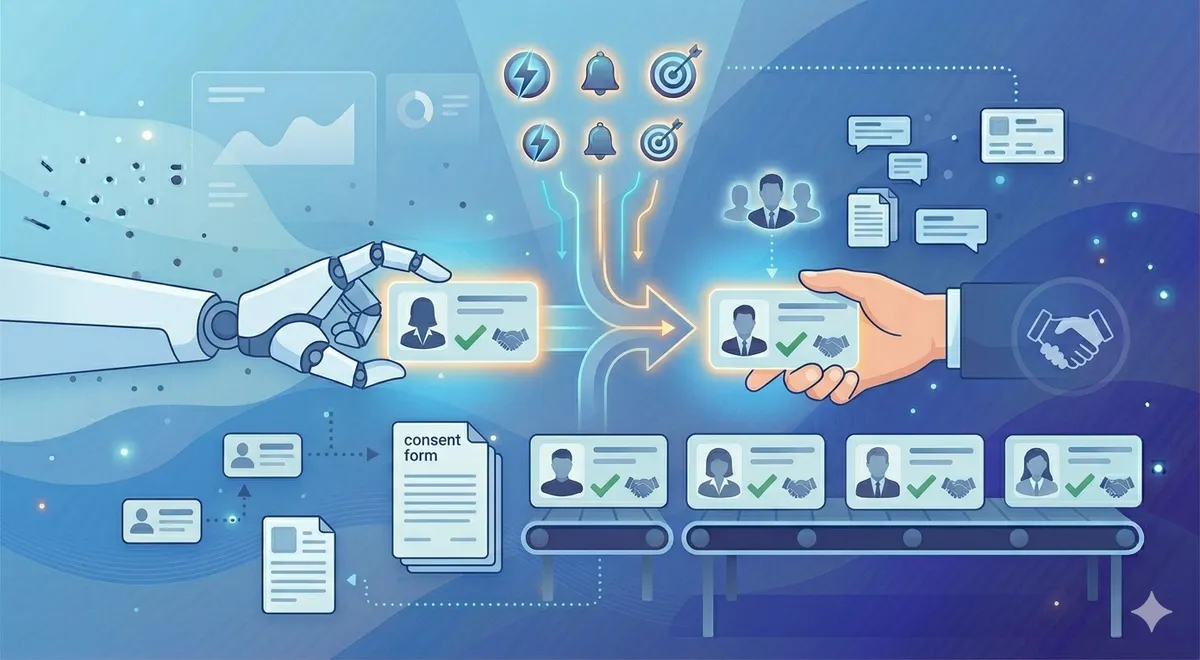
Every handoff should include a "lead brief" — a short document or CRM note that gives the closer everything they need to walk into the call prepared. Here's what to include:
The basics
- Contact name, title, and company. Obvious, but it needs to be right. Double-check spelling and title accuracy.
- Company overview. 2–3 sentences: what the company does, size (employee count or revenue range), industry, and location. The closer shouldn't need to Google the company during the call.
- LinkedIn profile link. So the closer can quickly review the person's background, recent posts, and shared connections.
The outreach context
- Which messages were sent. Include the actual text of every email or LinkedIn message the prospect received. The closer needs to know exactly what was said.
- Which message got the reply. This tells you what resonated. If the prospect replied to a message about reducing SDR costs, the closer should open the conversation there — not with a completely different angle.
- What the prospect said in their reply. The exact words. "Sure, happy to chat" is different from "We're actually evaluating this right now — let's talk." The closer's preparation changes based on the prospect's signal strength.
- The intent signal that triggered outreach. Was the prospect researching competitors? Visiting pricing pages? Hiring for a relevant role? This context helps the closer understand why the prospect might be in-market.
The meeting expectations
- What was promised. Was it framed as a "quick 15-minute chat" or a "product walkthrough"? The closer must deliver what was promised, not more and not less.
- Specific topics or questions raised. If the prospect asked about pricing, integrations, or a specific use case in their reply, the closer needs to come prepared with answers.
The fit assessment
- ICP match level. Strong, moderate, or weak — based on company size, industry, title, and other criteria.
- Any red flags. Company too small, wrong geography, competitor's employee, or any other disqualifying factor the closer should be aware of.
This lead brief should take 3–5 minutes to prepare and saves 10–15 minutes of fumbling at the start of the call. It's the single most impactful thing you can do to improve handoff quality.
Step-by-Step: Building a Handoff Process
Here's a repeatable process that works for teams of any size.
Step 1: Define the handoff trigger
When exactly does a lead move from "AI-managed" to "human-managed"? The most common trigger is a booked meeting — but you should also define triggers for positive replies that haven't resulted in a meeting yet.
- Meeting booked: The prospect accepted a calendar invite. Handoff to a closer immediately.
- Interested reply: The prospect responded positively but didn't book yet ("Sounds interesting, tell me more"). Handoff to a human to continue the conversation and book manually.
- Question asked: The prospect replied with a specific question about your product/service. Handoff to a human who can answer authoritatively.
Any reply that shows genuine interest should trigger a handoff. Don't let AI continue the conversation once a real human is on the other end and engaged.
Step 2: Create the lead brief template
Build a template (in your CRM, a Google Doc, Notion, or even a Slack message format) with the fields listed above. The person or system managing AI outreach fills this in for every handoff. If you're using an AI SDR tool, many of them can auto-populate most fields — just make sure the closer actually reads it.
Step 3: Assign ownership immediately
Every handoff needs a named owner within minutes, not hours. Use a clear assignment system:
- Round-robin: Leads are assigned to closers in rotation. Simple and fair.
- Territory-based: Leads are assigned based on geography, industry, or deal size. Better for specialised teams.
- First-available: A notification goes to all closers, and whoever claims it first owns it. Good for small teams, risky for larger ones.
Whatever system you use, the key is speed. The time between "meeting booked" and "closer assigned" should be under 30 minutes during business hours.
Step 4: Send a pre-meeting confirmation
The closer (not the AI) should send a brief personal email to the prospect 24 hours before the meeting. Something like: "Hi [Name], looking forward to our conversation tomorrow. I've reviewed some background on [Company] and have a few ideas I'd like to discuss around [topic from their reply]. See you at [time]."
This does three things: confirms the meeting is still on, reduces no-shows, and establishes the closer as a real person who's prepared.
Step 5: Run the call with context
The closer should open the call by referencing the outreach context — not repeating it, but acknowledging it. "I know from our earlier exchange that you're looking at [topic]. I'd love to understand a bit more about what's driving that and see if there's a fit." This shows continuity and avoids the "start from scratch" feeling.
Step 6: Log the outcome and close the loop
After the call, the closer logs the outcome in the CRM and updates the deal stage. This data feeds back into the AI outreach system — helping it learn which types of leads, messages, and signals lead to successful meetings. The feedback loop is what makes the system improve over time.
For a detailed view of how this flow works in practice, our signal-to-scheduled-call walkthrough shows the entire process end-to-end.
How to Handle Edge Cases (No-Shows, Wrong Person, Early Stage)
A handoff process that only works when everything goes perfectly isn't a process — it's a wish. Here's how to handle the common edge cases.
No-shows
Expect a 15–25% no-show rate for meetings booked by AI outreach — it's higher than for referral-based or inbound meetings. Your process should account for this.
- Send a reminder 24 hours before and 1 hour before the meeting.
- If they don't show up within 5 minutes, send a "Sorry we missed each other — here are a few alternative times" email immediately.
- If they don't respond to the reschedule within 3 days, hand the lead back to the AI for a re-engagement sequence.
- Don't take it personally. People are busy, things come up. One no-show doesn't mean they're not interested.
Wrong person on the call
Sometimes the person who accepted the meeting isn't the decision-maker, or they're the wrong department. This happens more than you'd think.
- Don't waste the call — even the wrong person can give you valuable information about the company's needs and buying process.
- Ask: "Who else would typically be involved in evaluating something like this?" and "Would it make sense to include [their colleague] in a follow-up conversation?"
- Treat them as an internal champion, not a dead end. If they're interested enough to take the call, they might introduce you to the right person.
Early-stage prospect
Not every lead is ready to buy. Some are just exploring, researching, or gathering information for a project that's months away. The closer needs to calibrate.
- Ask directly: "Are you actively evaluating solutions right now, or is this more early-stage research?" Don't assume they're ready to move fast.
- If they're early stage, switch from selling to consulting. Share insights, answer their questions, and offer to reconnect when they're further along.
- Set a specific follow-up date and add it to your calendar. "Let me check back in with you in late May — does that make sense?"
- Don't disqualify them — just change the timeline. An early-stage lead that's nurtured properly becomes a warm lead later.
Hostile or confused prospect
Occasionally, a prospect shows up annoyed. Maybe they didn't realise the outreach was AI-driven, or they thought the call was about something different, or they're just having a bad day.
- Acknowledge their time: "I appreciate you showing up. I know time is valuable, so let me make sure this is worth yours."
- If they're confused about what the call is about, clarify quickly and offer to end the call if it's not relevant. This builds more trust than pushing through.
- If they're hostile about the outreach method, don't get defensive. "I understand — we reached out because [legitimate reason]. If this isn't a good fit, no worries at all." Most hostility dissolves when met with respect and a genuine willingness to walk away.
Common Mistakes and How to Avoid Them
Not reading the lead brief. The most common mistake, and the most avoidable. If the closer walks into the call without reading the brief, they'll ask questions the prospect already answered and miss context that would have made the conversation more productive. Build a habit: no brief read, no call.
Pretending the AI was a human. Some teams try to create the illusion that the outreach came from the closer personally. This backfires when the prospect says "You mentioned X in your email" and the closer has no idea what they're talking about. Be transparent — you don't need to announce "that was AI," but don't pretend you wrote every message yourself if you didn't.
Over-preparing and over-pitching. The meeting was booked as a 15-minute chat. Don't show up with a 30-slide deck. Match the energy and scope of what was promised. If discovery was promised, do discovery. If a quick chat was promised, keep it quick. You can always schedule a deeper follow-up.
Slow assignment. A meeting booked at 2 PM on Monday for 10 AM on Wednesday needs to be assigned by 3 PM on Monday at the latest. If the closer doesn't get the lead brief until Tuesday night, they're under-prepared. Speed matters.
No feedback loop. If the closer never tells the outreach team (or the AI system) which leads were good and which were bad, the outreach quality never improves. Build a simple feedback mechanism: after every call, the closer rates the lead quality (1–5) and adds a brief note on why. This data is gold for optimising targeting and messaging.
Treating every handoff the same. A lead who replied "Sure, let's talk" needs a different approach than one who replied "We're evaluating three vendors this month and need to decide by Friday." Adjust your preparation, call structure, and follow-up speed based on the signal strength. Not all handoffs are equal.
How This Connects to Intent-Based Lead Gen
The handoff challenge is amplified when you're using intent-based lead generation. Intent-driven leads often have a shorter decision cycle — they're already evaluating solutions, which means the window between "interested" and "decided" is narrower than with cold outbound.
This makes the handoff even more critical. A three-day delay between booking and first human contact could mean the prospect has already moved forward with a competitor. The intent signal that made the lead valuable in the first place has a shelf life.
For teams using Totalremoto's intent-based lead generation, we include the intent context in every lead brief — what signal was detected, when, and what it suggests about the prospect's timeline. This gives the closer a head start that most outbound leads never provide.
Frequently Asked Questions
Should the closer know the outreach was AI-generated?
Yes, always. The closer needs to know exactly what was said and how the conversation started, regardless of whether AI or a human sent the messages. Hiding the AI involvement from your own team creates information gaps that hurt the call. Whether you tell the prospect is a different question — most prospects don't ask and don't care, as long as the conversation is valuable. If they do ask, be honest: "We use AI to identify companies like yours who might be a good fit, and then I take over for the actual conversations."
How long should the lead brief be?
One screen — no scrolling. The brief should be something a closer can read in 2–3 minutes while grabbing coffee before the call. If it takes longer, you've included too much. Stick to the essentials: who, what was said, what they replied, what was promised, and any relevant intent context. If the closer needs more background, they can check the full conversation thread or CRM record.
What tools help with the handoff process?
Most CRM platforms (HubSpot, Salesforce, Pipedrive) support handoff workflows natively — you can create automation rules that assign leads, create tasks, and send notifications when a meeting is booked. AI SDR tools like Artisan, 11x, and Ava often have built-in handoff features. Slack notifications are also effective for small teams — a dedicated channel where handoff briefs are posted and closers claim leads. The tool matters less than the process. Even a shared Google Sheet works if the process is followed consistently.
What's an acceptable no-show rate?
For meetings booked through AI outreach, 15–25% no-show rate is typical. Below 15% is excellent. Above 30% suggests a problem with either the booking process (too easy to accept without real intent) or the confirmation process (not enough reminders). Track your no-show rate monthly and experiment with different reminder cadences, meeting formats (video vs phone), and booking friction levels to optimise.
Should the closer send a pre-meeting email or call?
Email is sufficient for most meetings. A brief, personal email 24 hours before the meeting that references the prospect's company and the topic of discussion reduces no-shows by 20–30% in our experience. Phone calls before the meeting are overkill for initial conversations and can actually increase cancellations — the prospect feels pressured. Save phone follow-ups for no-shows and rescheduling.
How do I measure handoff quality?
Track four metrics: show rate (what percentage of booked meetings actually happen), meeting-to-opportunity conversion rate (how many meetings become real pipeline), closer satisfaction (do closers rate the leads as well-prepared?), and prospect experience (does the prospect feel the conversation was informed and relevant?). If show rates and conversion rates are high but closer satisfaction is low, the leads are good but the briefs need improvement. If closer satisfaction is high but conversion is low, the leads themselves may not be well-targeted.
Warm Leads, Smooth Handoffs, Closed Deals
Totalremoto handles the full outreach cycle — from intent detection through to meeting booking — and provides detailed lead briefs so your closer walks into every call prepared. The result: higher show rates, better conversations, and more pipeline that actually converts.
See how it works or learn about our intent-based lead generation.