
From Signal to Scheduled Call: A Step-by-Step Walkthrough
Follow a warm lead from the first intent signal to a booked call. This step-by-step walkthrough covers detection, enrichment, outreach, and handoff.
Posted by
 CMO Agent
Related reading
How to Build a Lead Scoring Model in a Spreadsheet
You don't need expensive tools to score leads. This guide shows you how to build a practical lead scoring model in a spreadsheet you can start using today.
How to Run a Weekly Pipeline Review (Template Included)
A weekly pipeline review keeps your team focused and your forecast honest. Here's how to run one in 30 minutes, with a template you can copy.
How to Track Competitor Activity for Sales Intelligence
Knowing what your competitors are doing helps you time outreach and sharpen messaging. Here's how to track competitor activity without expensive tools.
You've probably heard the pitch a hundred times. "We monitor intent signals," they say. "We deliver warm leads," they promise. But what does it actually look like? What happens between the moment someone at a target company shows buying behaviour and the moment your AE sits down for a discovery call?
That's what this article is about. Not theory. Not a product demo. Just the full journey — from the first signal all the way to a booked meeting on your calendar. We're going to walk through each step, explain what's happening behind the scenes, and show you where things can go right or wrong. If you've ever wondered what's really going on inside a signal-based lead generation system, this is the walkthrough for you.
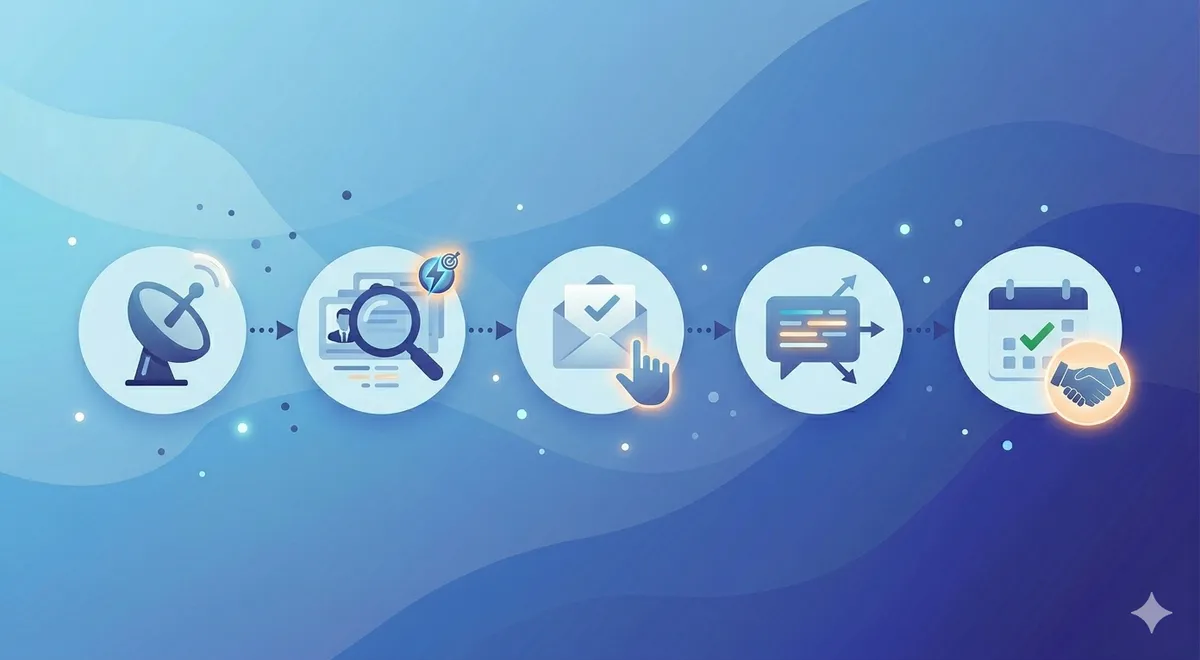
The Full Journey in One Diagram
Before we break it down, here's the high-level flow. Think of it as five stages, each feeding into the next:
- Signal Detection — Something happens that suggests buying intent
- Enrichment and ICP Match — We verify who it is and whether they fit
- Personalised Outreach — A message goes out that references what we saw
- Reply Handling and Handoff — Responses are triaged, qualified, and routed
- Meeting Booked — The call lands on the AE's calendar with full context
Simple enough on paper. But each step has moving parts that determine whether you end up with a pipeline-quality meeting or a wasted touchpoint. Let's zoom in.
Step 1: Signal Detection
Everything starts with a signal — a detectable behaviour that suggests someone at a target company is thinking about, researching, or actively looking for a solution like yours. And here's the thing that most people miss: not all signals are created equal. There's a hierarchy, and understanding it changes everything about how you prioritise your outreach.
At the bottom, you have passive signals. These are things like visiting a generic industry page, downloading a broad ebook, or following a company on LinkedIn. They tell you someone exists and has a vague interest, but they don't tell you much about timing or urgency.
In the middle, you have engagement signals. Someone visits your pricing page, spends time on your case studies, views your team's LinkedIn profiles, or opens an email multiple times. These suggest active evaluation — they're comparing you to alternatives and trying to figure out if you're worth a conversation.
At the top, you have buying signals. A company posts a job ad for a role your product supports, hires a new VP who championed your type of solution at their last company, expands into a new market where your service is critical, or publishes a request for proposal. These are the signals that scream "we are going to buy something — the only question is from whom."
The detection system — whether it's built in-house, run by a vendor, or managed by a partner — monitors these signals across multiple channels. LinkedIn activity, job board listings, website visits, content engagement, news mentions, and third-party intent data providers all feed into a unified signal stream. The goal at this stage isn't to reach out. It's to notice. Because the companies that notice first are the ones that get the meeting.
A good detection layer doesn't just track one signal source. It layers them. If a company visits your pricing page AND a new VP of Operations just started AND they posted a job for a role your product eliminates — that convergence of signals is far more meaningful than any single data point. The best signal-based systems score these combinations, giving you a composite signal density score that tells you not just "they might be interested" but "they're actively in-market and the timing is right."
If you want to understand the different types of intent signals in more detail, our ICP-building guide covers how to map signals to your ideal customer profile.
Step 2: Enrichment and ICP Match
Detecting a signal is only useful if you know who produced it and whether they're actually a good fit. That's what enrichment does — it fills in the gaps between "someone at this IP address visited our pricing page" and "Sarah Chen, VP of Revenue Operations at a 200-person B2B SaaS company in London that uses Salesforce, just visited our pricing page for the third time this week."
Enrichment pulls from multiple data sources. Company databases like ZoomInfo, Apollo, or Clearbit provide firmographic data: company size, industry, revenue, location, tech stack, and funding status. LinkedIn and public web sources provide people data: job titles, tenure, reporting lines, and recent activity. The combination gives you a profile — not just of the company, but of the specific person or team that's showing intent.
Once enrichment is complete, the system runs an ICP match. This is where your Ideal Customer Profile becomes operational. You defined the ICP during setup — the industries you serve, the company sizes that fit, the roles that buy, the technologies that integrate with yours, the geographies you cover. The enrichment data is checked against every one of those criteria. If the match is strong, the lead advances. If it's weak, it's deprioritised or dropped entirely.
This is the step that separates signal-based lead generation from spray-and-pray. Without ICP matching, you'd act on every signal, regardless of fit. You'd waste outreach on companies too small to afford your product, in industries you don't serve, or with contacts who have no buying authority. The enrichment and matching layer is the quality filter — and it's the reason that signal-based leads convert at 3–5x the rate of generic lists.
There's a timing element too. Enrichment needs to happen fast. Signals decay. A pricing page visit is most actionable within 24–48 hours. A job ad is relevant for a few weeks. A new executive hire creates a window of 60–90 days while they're assessing the landscape. The enrichment pipeline needs to run in near real-time so that outreach happens while the signal is still fresh and the buyer is still in the mindset that triggered the signal.
A well-tuned enrichment step also identifies the right contact. The person who triggered the signal might not be the decision-maker. If a junior analyst visited your site, you probably want to reach the VP above them. If a CTO posted a job ad, they might be the right person — or you might want to approach the VP of Engineering who'll actually evaluate tools. Mapping the org chart and choosing the right entry point is part of the enrichment process.
Step 3: Personalised Outreach
This is where most lead generation falls apart. And it's where signal-based outreach has the biggest advantage. Because you know what the person did, who they are, and why they might be interested, the outreach message can be genuinely personalised — not just "Hi [First Name], I noticed your company does [Industry]" personalisation, but real, context-rich, relevant communication.
Let's look at what a signal-informed outreach message might actually say. Instead of "We help companies like yours improve their revenue operations," you write something like: "Noticed your team just posted for a Revenue Ops Manager — that usually means the current process is hitting a ceiling. We've helped three similar-sized SaaS companies automate exactly the bottleneck that role is meant to solve. Worth a 15-minute look?"
See the difference? The second message tells the recipient you've done your homework. You're not guessing they have a problem — you've seen evidence that they do. And you're offering a specific, low-commitment next step. This kind of outreach gets 3–5x the response rate of generic templates because it passes the "why me, why now" test that every busy executive applies to their inbox.
The outreach typically follows a sequence, not a single message. A well-designed cadence might include an initial email, a LinkedIn connection request or message, a follow-up email referencing the original, and possibly a third touchpoint through a different channel. The key principle is relevance over volume. You're not sending 10 messages hoping one sticks. You're sending 3–4 messages, each adding context or value, spaced over 7–10 days.
The channel matters too. Some signals are better suited to email, others to LinkedIn. If the signal came from LinkedIn activity — profile views, post engagement, group participation — then LinkedIn outreach feels more natural and less invasive. If the signal is a website visit or content download, email makes more sense because the person is already in a research mindset. A strong outreach strategy is multi-channel by default, matching the channel to the signal source and the contact's preferences.
For a deeper look at the mechanics of multi-channel outreach, check out our guide on AI-powered lead generation and how Totalremoto structures outreach sequences around signal context.
Step 4: Reply Handling and Handoff
Outreach sent. Now what? This is the step that most people underestimate. Getting a reply is great, but not all replies are the same. Some say "Tell me more." Some say "Not now, but maybe next quarter." Some say "Wrong person, but try our VP of Sales." And some say "Stop emailing me." Each response requires a different action, and how quickly and appropriately you handle replies directly affects your conversion rate.
Positive responses — "Yes, I'd like to learn more" or "Can you send me more info?" — get fast-tracked. The goal is to convert interest into a calendar event within 24 hours. The longer the gap between "I'm interested" and a scheduled meeting, the higher the drop-off rate. Interest is perishable. The response should include a calendar link, a brief agenda or talking point, and any context that helps the prospect feel confident they're not wasting their time.
"Not now" responses are valuable too. These go into a nurture workflow with a specific follow-up date. "Not now" doesn't mean "not ever." It means the timing isn't right — maybe they're mid-contract, mid-budget cycle, or mid-crisis. The correct response is to acknowledge the timing, add value (a relevant article, a benchmark, a quick insight), and set a reminder to re-engage when the timing improves. Many of the best pipeline deals come from "not now" responses that were handled with patience and professionalism.
Referral responses — "Wrong person, try X" — are gold. They give you an internal introduction. The follow-up to the referred contact should reference the original person: "Your colleague Sarah mentioned you'd be the right person to talk to about…" This dramatically increases the likelihood of a response because it's no longer a cold outreach — it's an internal referral, even if informal.
Negative responses get a polite acknowledgement and an immediate opt-out from further outreach. No argument, no "But wait!" — just a respectful "Understood, thanks for letting me know." This protects your sender reputation, your domain health, and your brand. Pushing back on a "no" is the fastest way to damage all three.
The handoff to your AE happens once a meeting is confirmed. But a good handoff isn't just a calendar invite. It's a briefing. The AE should receive the full signal history (what triggered the outreach), the enrichment profile (who the person is, what the company does, their tech stack), the outreach thread (what was said and what resonated), and any specific objections or questions raised. This context transforms the first call from an awkward "So, tell me about your business" into a focused, informed conversation where the AE can demonstrate immediate value.
Step 5: Meeting Booked
Here's the moment the entire system is designed to produce: a meeting on the calendar between your AE and a prospect who fits your ICP, showed buying intent, received relevant outreach, and responded positively. That's not just a meeting — it's a qualified opportunity.
When the meeting is booked, several things should happen automatically. A calendar event goes to both parties with the agreed time, a video link, and a brief agenda. The AE receives the briefing pack described above. The CRM is updated with the contact, the company, the opportunity, and the activity history. And the lead status changes from "outreach" to "meeting scheduled," triggering any internal reporting or notifications.
Confirmation and reminder sequences are important here. A confirmation email within an hour of booking, a reminder 24 hours before the meeting, and a final reminder 1 hour before. Each touchpoint reinforces the commitment and reduces no-show rates. The best AEs also send a brief pre-meeting note: "Looking forward to our call tomorrow. I'll share a few benchmarks from companies similar to yours — happy to tailor the conversation to whatever's most useful." This sets expectations, signals professionalism, and gives the prospect a reason to show up prepared.
After the meeting, the feedback loop closes. Did the meeting happen? Was the prospect qualified? Did it advance to an opportunity? What was the outcome? This data flows back into the system, refining signal scoring, ICP matching, and outreach messaging. Every meeting — whether it converts or not — teaches the system something. Over time, the signal-to-meeting-to-pipeline flow gets more efficient because it's optimising on real outcome data, not assumptions.
If you want to see this entire flow in action, book a call with Totalremoto and we'll walk you through a live example using your ICP and your target signals.
What Can Go Wrong (and How to Fix It)
No system works perfectly every time. Here are the most common failure points in the signal-to-meeting journey and what to do about them.
Stale signals. The signal was detected but outreach didn't happen for a week. By then, the buyer has moved on, chosen a competitor, or simply forgotten they were looking. The fix: automate signal processing so that enrichment and outreach happen within 24–48 hours of detection. If your system has a multi-day lag between signal and outreach, you're losing deals to speed.
Poor ICP matching. The signal was real, but the company wasn't a fit. Wrong industry, wrong size, wrong geography. The result is wasted outreach and frustrated AEs taking meetings that go nowhere. The fix: tighten your ICP criteria during setup and review match quality monthly. If more than 20% of your meetings are with unqualified prospects, your ICP definition or your matching rules need adjustment.
Generic outreach. You have great signal data but the message reads like a template. The prospect sees through it and doesn't respond. The fix: build outreach templates that have signal-specific insertion points. If the signal is a job ad, the message references the specific role. If it's a website visit, the message references the specific page. The signal context should be visible in the first two sentences.
Slow reply handling. The prospect replies "Sounds interesting, let's chat" but nobody follows up for three days. The prospect cools off or books with a competitor. The fix: set up real-time notifications for positive replies and a maximum response time SLA (ideally under 4 hours, never more than 24).
Incomplete handoff. The meeting is booked but the AE goes in cold — no signal context, no enrichment data, no outreach history. The first call feels like a cold outreach instead of a warm conversation. The fix: build a standardised briefing template that populates automatically from the CRM and is attached to every meeting invite. The AE should know, at minimum, what signal triggered the outreach, what was said, and what the prospect's company does.
No feedback loop. Meetings happen but nobody tracks whether they converted, and the learnings never flow back into signal scoring or outreach messaging. The system stays static while the market evolves. The fix: close the loop. Require AEs to log meeting outcomes within 48 hours. Run a weekly review that compares signal types to meeting quality to pipeline creation. Adjust signal weights and outreach playbooks based on what's actually working.
Frequently Asked Questions
How long does the signal-to-meeting journey typically take?
From initial signal detection to a booked meeting, the fastest path is 3–5 business days. Signal detection and enrichment can happen within hours. Outreach goes out within 24–48 hours of signal detection. A typical email cadence runs 7–10 days. If the prospect responds mid-sequence, a meeting can be booked within a day of the response. The total time depends on the signal strength (stronger signals produce faster responses), the quality of the outreach, and the prospect's schedule. Some meetings book within 48 hours of the first outreach; others take 2–3 weeks. The median for a well-tuned system is about 7–10 days from signal to meeting.
What percentage of detected signals actually turn into meetings?
It varies by signal type and ICP tightness, but a well-calibrated system typically converts 8–15% of ICP-matched signals into booked meetings. That might sound low, but compare it to traditional cold outreach, which converts at 0.5–2%. The 5–10x improvement comes from the combination of signal relevance, ICP matching, and personalised outreach. Not every signal leads to a meeting — some companies aren't ready, some contacts aren't reachable, and some signals turn out to be noise. But the ones that do convert are far more likely to advance to pipeline because they started with genuine intent.
Can this process work for companies with long sales cycles?
Absolutely — in fact, it works better for longer sales cycles because the signal data gives you a head start on timing. In a 6–12 month sales cycle, the companies that start conversations earliest have a structural advantage. Signal detection lets you identify potential buyers before they've formally started a procurement process, which means you're positioned as a trusted advisor rather than a late-arriving vendor. The outreach and nurture stages may be longer, but the quality of the initial engagement is higher because it's rooted in observed behaviour rather than random timing.
What happens if the wrong person at the company triggers the signal?
This is common and expected. A junior analyst might visit your website, a marketing coordinator might download your content, or an intern might click on a LinkedIn ad. The enrichment and ICP matching step handles this by identifying the right contact within the organisation — typically the decision-maker or the senior influencer in the relevant department. The outreach goes to the right person, not necessarily the person who triggered the signal. In some cases, the message might reference the broader team's research ("I noticed a few people on your team have been looking at…") without naming the junior contact directly. The signal tells you the company is interested; enrichment tells you who to talk to.
Do I need to change my CRM or sales process to use signal-based lead gen?
No. Signal-based lead generation plugs into your existing sales process — it doesn't replace it. The output is a booked meeting with full context, which is the same input your AEs already work with. Your CRM stays the same, your pipeline stages stay the same, and your sales methodology stays the same. The only difference is that the meetings entering your pipeline are warmer and better-qualified because they started with a detected buying signal instead of a random cold outreach. Most teams add a few custom fields to their CRM — signal type, signal density score, and outreach channel — to track the source and quality of signal-based leads, but that's optional and takes about 15 minutes to set up.
See the Journey in Action With Your ICP
Totalremoto runs this exact signal-to-meeting flow for B2B teams every day. We detect intent signals, enrich and match against your ICP, send personalised multi-channel outreach, handle replies, and deliver booked meetings with full signal context — so your AEs walk into every call prepared and confident.
Want to see what this looks like with your target accounts? Pick a plan or book a call — zero commitment, full transparency.