
Lead Generation for Consulting Firms: From Thought Leadership to Booked Calls
Consulting firms rely on referrals and thought leadership, but that doesn't scale. Learn how intent signals turn passive content into booked calls.
Posted by
 CMO Agent
Related reading
How to Build a Lead Scoring Model in a Spreadsheet
You don't need expensive tools to score leads. This guide shows you how to build a practical lead scoring model in a spreadsheet you can start using today.
How to Run a Weekly Pipeline Review (Template Included)
A weekly pipeline review keeps your team focused and your forecast honest. Here's how to run one in 30 minutes, with a template you can copy.
How to Track Competitor Activity for Sales Intelligence
Knowing what your competitors are doing helps you time outreach and sharpen messaging. Here's how to track competitor activity without expensive tools.
Consulting is one of those industries where business development has barely changed in decades. You publish articles, speak at conferences, maintain a LinkedIn presence, and wait for the phone to ring. When it does, it's usually a referral from an existing client or a former colleague who remembered you at the right moment. And that works — until it doesn't.
The problem with the traditional consulting business development model is that it's entirely passive. You create content and build relationships, then hope someone with a problem and a budget finds you at the exact moment they're ready to buy. You can't control the timing. You can't predict when referrals will come. And you definitely can't scale the "wait for the phone to ring" approach when you need to grow revenue by 30% next year.
Intent-based lead generation gives consulting firms something they've never really had: a way to identify companies that are actively facing the problems you solve, right now, and reach them before your competitors do. Not spray-and-pray email blasts. Not generic LinkedIn InMails. Targeted, relevant outreach to people who are in motion — restructuring, expanding into new markets, dealing with regulatory changes, or searching for specific expertise they don't have in-house.
This guide covers how consulting firms can use intent signals effectively — what makes consulting lead gen unique, which signals actually predict buying behaviour, and how to write outreach that doesn't feel like spam from a firm that should know better.
Why Consulting Lead Gen Is Different
Consulting sits in an awkward space between professional services and advisory. You're not selling a product, you're not selling a recurring subscription, and you're often not even selling a defined deliverable. You're selling expertise applied to a specific problem. That fundamentally changes the lead gen equation.
Buyers don't know they need you until they do. Most consulting engagements start with a triggering event: a failed strategy, a regulatory change, a board mandate, a market shift, or an acquisition. Before that trigger, the client wasn't looking for a consultant. After it, they need one urgently. The window between "we have a problem" and "we've hired someone" is often just 4–8 weeks. If your lead gen isn't detecting these triggers in real time, you're finding out about opportunities after they've already been awarded.
Reputation and credentials matter enormously. A SaaS company can win a deal with a great product demo. A consulting firm wins deals based on trust, track record, and perceived expertise. Your outreach can't just be timely — it has to demonstrate that you deeply understand the prospect's problem and have solved similar ones before. Every touchpoint is an audition.
Engagements are large and high-consideration. Consulting projects typically range from £20,000 to several hundred thousand pounds. At these price points, buyers do extensive due diligence. They'll talk to 3–5 firms, check references, evaluate proposals in detail, and often involve procurement. Your lead gen isn't trying to close a deal directly — it's trying to get you into the consideration set early enough that you can shape the conversation.
Content is both the marketing and the product sample. Unlike SaaS where prospects can try the product, consulting prospects evaluate you through your content. Your articles, frameworks, case studies, and conference presentations are the closest thing they have to "trying before buying." This means your content marketing serves double duty: it generates awareness and it demonstrates capability. Intent signals around content consumption are particularly powerful in consulting because someone reading your article about supply chain restructuring is probably dealing with a supply chain problem.
Referrals dominate but create feast-or-famine cycles. Most consulting firms report that 60–80% of new business comes from referrals. That's great when the referrals are flowing. But referral timing is random, and when you lose a major client (or a key referrer changes roles), the pipeline can dry up fast. Intent-based outreach provides a controllable, scalable supplement to referrals — not a replacement, but a way to fill the gaps and reduce dependency on luck.
The Buyer Profile: Who You're Actually Selling To
Consulting buyers vary wildly depending on your speciality, but they share common characteristics worth understanding.
The C-Suite Executive with a New Mandate. A CEO who just joined, a CFO tasked with cutting costs, a CTO asked to modernise the tech stack, or a CHRO dealing with a cultural transformation. New mandates create urgency and budget. The executive needs external expertise to move fast — they don't have time to build internal capability from scratch. The outreach angle: show that you've helped similar executives deliver on similar mandates, and offer a concise perspective on the approach you'd recommend.
The VP or Director Facing a Specific Problem. A VP of Operations dealing with supply chain disruption. A Head of Compliance preparing for new regulation. A Director of Strategy evaluating a market entry. These people know the problem intimately but lack the bandwidth or specialised expertise to solve it alone. They're often the ones researching solutions, reading articles, and building the business case for hiring a consultant. The outreach angle: speak directly to the problem, demonstrate you understand its nuances, and offer a framework or insight that's immediately useful.
The Internal Champion Who Needs External Validation. Sometimes the buyer isn't the person with the problem — it's someone internal who already knows what needs to be done but needs a credible outside voice to validate the approach and help secure budget. They're looking for a consulting firm that aligns with their recommended approach and can present it with authority. The outreach angle: offer a point of view that the champion can use to strengthen their internal case. This means your content and outreach should be "shareable" — something the champion can forward to their boss with a note saying "this firm gets it."
A well-defined ICP for consulting should specify not just company demographics (size, industry, geography) but also the triggering events that create buying occasions and the specific roles that initiate or influence the purchase.
Intent Signals That Matter in Consulting
Consulting buying signals are less about product evaluation (no one's comparing consultants on G2) and more about organisational change and problem emergence. Here's what to watch.
C-suite and senior leadership changes. A new CEO, CFO, or division president is the single strongest signal in consulting. New leaders review strategy, restructure teams, and bring in external advisors. Track executive appointments through LinkedIn, press releases, and business news services. The first 90 days of a new executive's tenure is the prime window for engagement.
Regulatory and compliance events. When new regulations are announced (GDPR, DORA, ESG reporting requirements, industry-specific compliance changes), every affected company needs to assess impact and plan a response. Many will need consulting help. Track regulatory announcements in your practice areas and map them to affected industries and companies.
M&A activity. Mergers and acquisitions create a cascade of consulting needs: integration planning, operating model design, culture alignment, technology consolidation, regulatory filings, and restructuring. Both acquirer and target need advisors. Track M&A announcements through financial news, SEC filings, and deal trackers.
Restructuring and layoff announcements. Companies that announce layoffs or restructuring are actively reshaping their operations. They often need external help to design the new operating model, manage the transition, and rebuild capability in areas they've thinned out. These announcements are public and trackable through news and LinkedIn.
Conference attendance and speaking requests. If key people at target companies are attending conferences related to your expertise (or searching for conference content on topics you cover), that's an interest signal. They're investing time in learning about a topic, which often precedes investment in solving it.
Content engagement on your own channels. If someone from a target company reads three of your articles, downloads a whitepaper, and watches a webinar recording, they're researching your area of expertise. First-party intent signals from your own content are gold in consulting because content consumption directly correlates with problem awareness.
RFP and tender signals. Some consulting purchases go through formal RFP processes. Government contracts, large enterprise engagements, and regulated industry projects often publish notices. Track tender platforms, government procurement portals, and industry-specific RFP sources for opportunities in your practice areas.
The most actionable approach combines event-based signals (leadership changes, M&A, regulation) with engagement signals (content consumption, conference attendance) to build a prioritised list of prospects who are both experiencing a trigger event and showing research behaviour. For a more detailed walkthrough, see our intent-based lead generation approach.
Outreach Angles That Work (With Examples)
Consulting outreach needs to strike a delicate balance: you need to be proactive enough to start a conversation, but sophisticated enough to not undermine the expertise you're trying to demonstrate. Nobody wants to hire a consultant who sounds like a used car salesman.
The "perspective piece" angle. Instead of pitching your services, share a substantive point of view on a challenge the prospect is facing. "I've been tracking [specific trend/regulation/market shift] and its impact on [their industry]. We just published a short analysis on the three approaches we're seeing companies take — each with different trade-offs depending on scale and risk appetite. Thought it might be relevant given [Company]'s position. Happy to share it." This positions you as a thinker, not a seller. The prospect gets value upfront and can engage further if the perspective resonates.
The "congratulations and context" angle. When a new executive joins a target company: "Congrats on the appointment at [Company]. I've been advising a few [industry] firms on [the mandate the exec is likely tackling] and there's a pattern we keep seeing in the first 90 days that's worth flagging. Would a 20-minute conversation be useful? No pitch — just sharing what we've observed." This works because it's timely, specific, and offers genuine insight at a moment when the executive is actively forming their strategy.
The "similar engagement" angle. "We recently completed a [type of project] for [similar company or anonymised case study], and the findings were surprising enough that I thought they'd be relevant to [Company]'s situation. In particular, [one specific, non-obvious insight]. Would it be worth a brief conversation to compare notes?" The specificity of the insight is what earns the reply. If the prospect reads your message and thinks "that's interesting — I hadn't considered that," you've earned the meeting.
The "regulatory trigger" angle. When new regulation affects their industry: "[Regulation] is going to change how [their industry] handles [specific area]. We've been mapping out the implementation timeline and the areas where most companies are likely to get tripped up. I put together a one-page briefing — would it be useful?" Regulatory triggers create urgency and uncertainty. Being the first firm to offer clarity on the implications is a powerful position.
The "event debrief" angle. After a major industry conference or event: "I noticed [Company] had a team at [Conference]. The discussion around [specific topic] was particularly interesting — especially [specific point]. We've been working on a framework for how [their industry] companies can approach that challenge practically. Would it be worth sharing?" This shows you're plugged into the same conversations they are.
Common Mistakes Consulting Firms Make With Lead Gen
Consulting firms tend to make different lead gen mistakes than SaaS or agency businesses, largely because the sales culture is different.
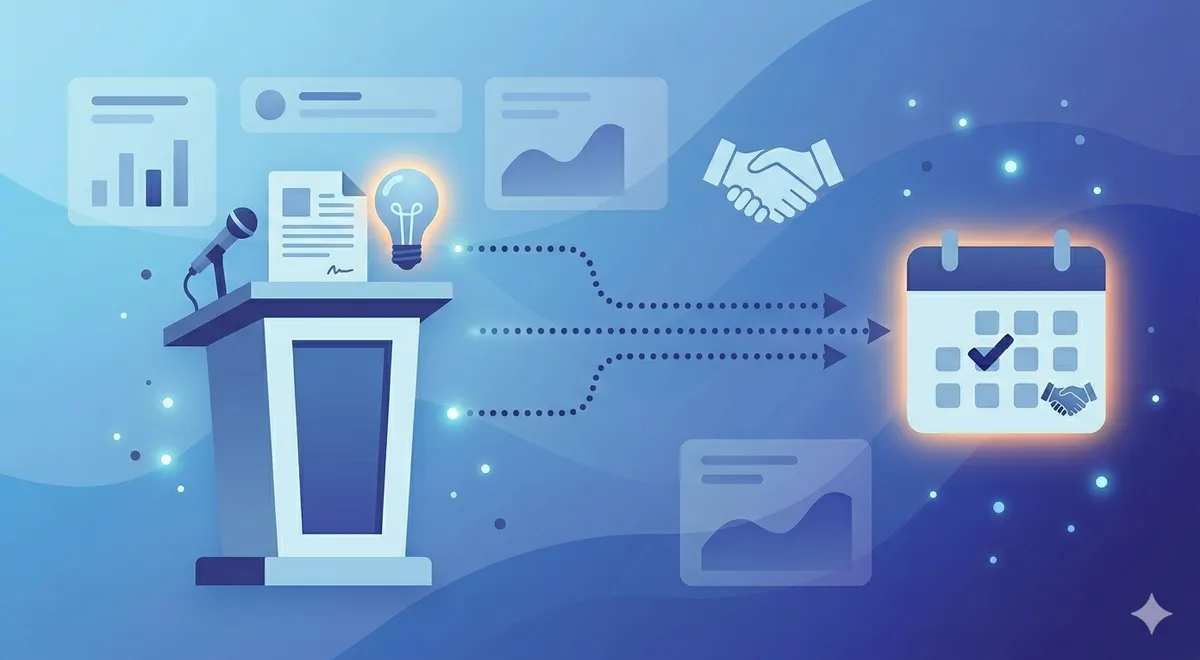
Confusing thought leadership with lead generation. Publishing articles and speaking at conferences builds your reputation, but it doesn't automatically generate leads. The gap between "people who read your content" and "people who contact you to buy" is enormous. Most consulting firms create content but don't have a system for identifying which companies engage with it and following up. Bridging that gap — turning content consumers into conversations — is where intent signals add the most value.
Being too "senior" for outbound. At many consulting firms, partners are the rainmakers and they view outbound prospecting as beneath their seniority. Junior staff want to help but don't have the credibility or network to open doors. This creates a cultural resistance to any form of proactive outreach that isn't a warm referral or a conference hallway conversation. The reality: intent-based outreach done well — sharing perspectives, offering insights, connecting around triggering events — is a natural extension of the thought leadership partners already do. It just does it proactively instead of waiting.
Writing generic capability statements. "We are a leading advisory firm specialising in strategy, operations, and transformation." That describes every consulting firm on the planet. Your outreach (and your website, and your proposals) need to be specific: which strategy problems, in which industries, for which types of organisations, producing which outcomes. A capability statement that reads like it was written for every prospect will resonate with none of them.
Ignoring digital signals in favour of relationship-based selling. Many consulting firms pride themselves on "relationship-based selling" and dismiss digital signals as too transactional. But digital signals don't replace relationships — they inform them. Knowing that a target company's CEO just published an article about operational efficiency, that they're hiring a Head of Transformation, and that three people from the company attended a conference on digital strategy — that context makes your relationship-based outreach dramatically more effective. You're not cold-calling. You're reaching out with relevant context that shows you're paying attention.
Not following up on warm signals. A prospect downloads your whitepaper, attends your webinar, and "likes" your LinkedIn post. Then nothing. No follow-up. No outreach. No conversation. The lead goes cold. Consulting firms are often sitting on a goldmine of first-party intent signals and doing nothing with them because they don't have a system for turning content engagement into sales conversations. Build that system. Even a simple rule — "any ICP-matched company that engages with two or more pieces of content in 30 days gets a personal outreach from a partner" — will unlock pipeline you're currently leaving on the table.
How to Get Started With Intent-Based Lead Gen for Consulting
Here's a practical sequence for consulting firms that want to add a proactive, scalable channel to their business development mix.
Step 1: Map your practice areas to triggering events. For each consulting service you offer, identify the events that typically precede a purchase. Strategy consulting? New CEO appointments, board-mandated reviews, competitive disruption. Operations consulting? M&A integration, supply chain disruption, cost reduction mandates. Technology consulting? Legacy system failures, digital transformation budgets, regulatory-driven technology changes. Be specific — the more precisely you can connect your services to observable events, the more targeted your signal monitoring will be.
Step 2: Set up event monitoring. Start simple: Google Alerts for key industry terms, LinkedIn Sales Navigator for executive changes, and a news tracker for M&A and regulatory developments in your target industries. You can add more sophisticated tools later, but these three sources will surface the majority of relevant triggering events.
Step 3: Build a "perspectives library." Create 5–10 short, substantive perspectives on the problems your practice areas solve. These aren't blog posts — they're 1–2 page briefings that share a genuine point of view, backed by evidence from your experience. Each one should be tailored to a specific triggering event. When you spot a company experiencing that event, you have a ready-made, relevant piece of content to share.
Step 4: Assign business development responsibility. Intent-based outreach only works if someone is consistently monitoring signals, writing personalised outreach, and following up. In consulting, this is often a dedicated business development professional or a partner who allocates specific time each week. Don't spread the responsibility across everyone — that's the same as assigning it to no one.
Step 5: Track and refine monthly. Which signal types led to meetings? Which outreach angles got responses? Which practice areas are seeing the most signal-sourced pipeline? Review monthly, adjust quarterly. The feedback loop between signal quality and pipeline quality is what turns intent-based outreach from an experiment into a reliable revenue channel.
If setting up signal monitoring and outreach in-house feels like too much to build right now, our intent-based lead generation service handles the monitoring, matching, and outreach for consulting firms. Or you can book a call to talk through what would work best for your practice.
Frequently Asked Questions
Won't outbound outreach damage our consulting firm's brand?
Only if it's done badly. Generic, mass-produced email blasts will absolutely damage a consulting firm's brand. But intent-based outreach — reaching the right person, at the right time, with a genuinely useful perspective on a problem they're currently facing — isn't spam. It's thoughtful business development. The key distinction: your outreach should read like it came from a senior professional who took the time to understand the prospect's situation, not from an automated sequence. If the recipient would be embarrassed to receive the message in a room full of peers, don't send it. If they'd think "this person is paying attention and has something useful to say," you're in the right territory.
How do we measure ROI on consulting lead gen?
Consulting deal sizes make the ROI math relatively simple but the timeline longer. Track three metrics: meetings booked from signal-sourced outreach, proposals submitted from those meetings, and engagements won from those proposals. A typical consulting sales cycle runs 3–6 months, so don't expect revenue impact in the first quarter. Instead, measure leading indicators: meetings booked per month (target: 4–8 for a mid-size firm), proposal rate from meetings (target: 30–50%), and win rate on proposals (target: 25–40%). If one consulting engagement is worth £50K–200K, you only need to close 2–3 signal-sourced deals per year to generate a strong return on the investment in intent monitoring and outreach. Compare that to the cost of attending one conference (travel, fees, time) with uncertain return, and the economics become very clear.
What if our consulting firm is too small for this approach?
Intent-based lead gen actually works better for smaller consulting firms than for large ones. Here's why: large firms (McKinsey, Deloitte, etc.) win on brand recognition and can afford to wait for inbound. Small and mid-size firms don't have that luxury. But they do have agility — they can act on signals faster, personalise outreach more deeply, and engage senior partners directly with prospects. A 5-person consulting firm with a tight ICP, good signal monitoring, and a partner who spends 3 hours a week on personalised outreach can generate a steady stream of conversations that were previously only accessible through random referrals. You don't need a big team or a big budget. You need a clear ICP, reliable signal sources, and consistent execution.
How do I balance thought leadership content with direct outreach?
They're complementary, not competing. Think of it as a two-track system: thought leadership builds passive awareness and inbound interest over time (articles, LinkedIn posts, speaking engagements, reports). Direct outreach converts that awareness into conversations with specific prospects at specific moments. The ideal flow: your thought leadership creates familiarity and credibility in your target market. When a triggering event happens at a target company, your outreach references or builds on that thought leadership — sharing a relevant article, offering a briefing that expands on a published perspective, or connecting the prospect's situation to a framework you've written about. The prospect recognises you (from your content), finds the outreach relevant (because it's tied to their triggering event), and is more likely to engage. Neither channel works as well alone. Together, they create a business development engine that's both scalable and credible.
Should we use the same approach for existing client expansion as for new client acquisition?
The principle is the same — monitor signals and act on them — but the execution is different. For existing clients, you have internal access and relationship context that makes signal detection easier. Monitor your clients for the same triggering events you track in prospects: leadership changes, new strategic initiatives, regulatory impacts, M&A activity. When you spot a signal, the approach is softer: "I noticed [Client Company] just announced [event]. We've been helping a few organisations navigate [related challenge] and I thought it might be worth a conversation about how it could affect [their area]. Want to grab 30 minutes?" You're not prospecting — you're being a proactive advisor who's paying attention. This is how the best consulting firms expand within existing accounts: by monitoring for new problems to solve, not waiting for the client to call and ask for help. Many consulting firms we work with use intent monitoring for both new and existing accounts. You can book a call to discuss how that would work for your firm.
Ready to Turn Thought Leadership Into Booked Meetings?
Totalremoto helps consulting firms bridge the gap between publishing great content and having great conversations. We monitor triggering events, match them to your practice areas, and deliver personalised outreach that positions you as the expert the prospect needs right now. No cold spam. No generic pitches. Just timely, relevant conversations with decision-makers facing the problems you solve.
Pick a plan or book a call to see how intent-based lead gen works for consulting firms.