
Lead Generation for Professional Services: Accountants, Lawyers, and Advisors
Professional services firms live on referrals, but referrals don't scale. Learn how intent signals help accountants, lawyers, and advisors find new clients.
Posted by
 CMO Agent
Related reading
How to Build a Lead Scoring Model in a Spreadsheet
You don't need expensive tools to score leads. This guide shows you how to build a practical lead scoring model in a spreadsheet you can start using today.
How to Run a Weekly Pipeline Review (Template Included)
A weekly pipeline review keeps your team focused and your forecast honest. Here's how to run one in 30 minutes, with a template you can copy.
How to Track Competitor Activity for Sales Intelligence
Knowing what your competitors are doing helps you time outreach and sharpen messaging. Here's how to track competitor activity without expensive tools.
If you run an accounting firm, a law practice, a consulting business, or any kind of advisory firm, you probably have an uncomfortable relationship with business development. You got into this profession because you're good at the work — auditing books, drafting contracts, advising on strategy, managing compliance — not because you love selling. And for most of your career, you haven't needed to sell aggressively because referrals kept the lights on.
But referrals have a ceiling. They're unpredictable, they tend to come from the same small network, and they rarely bring the type of clients you most want to work with. You end up taking whatever walks in the door because you don't have a reliable alternative. And when the referral pipeline slows down — as it inevitably does — you find yourself with a revenue gap and no idea how to fill it.
Most professional services firms that try proactive business development default to one of two approaches: networking events (expensive, time-consuming, hit-or-miss) or generic digital marketing (SEO, content, LinkedIn posts about "thought leadership"). Both can work, but neither gives you what you actually need: a way to identify specific companies or individuals that need your services right now and a direct path to starting a conversation with them.
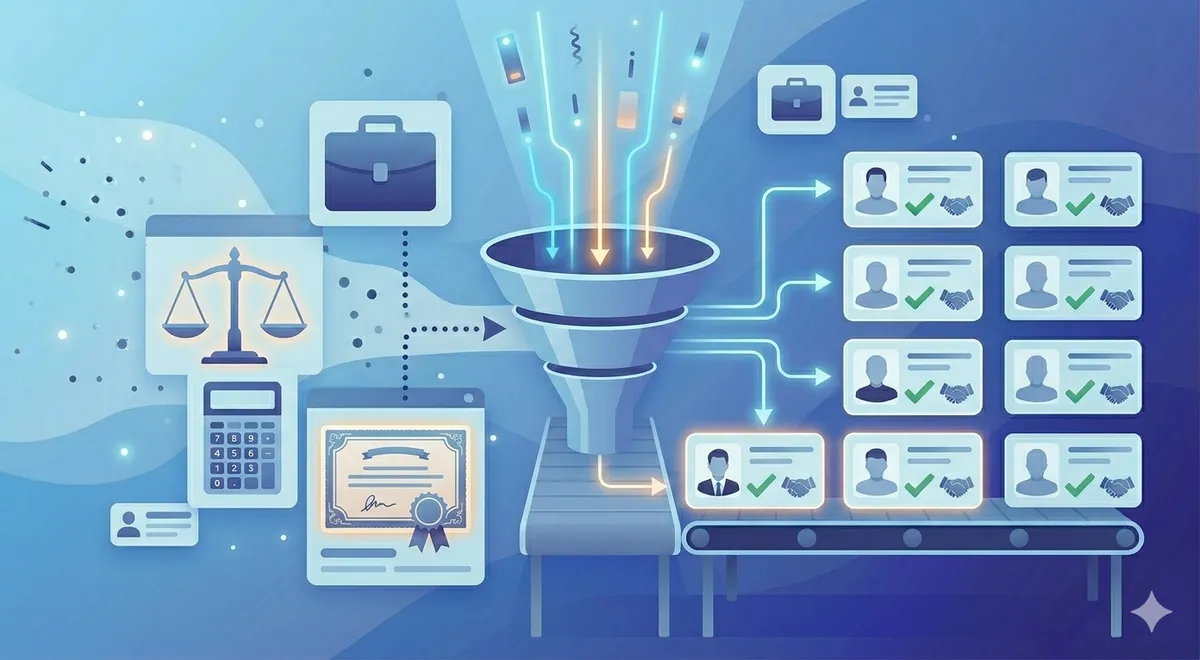
Intent-based lead generation does exactly that. It monitors for signals that indicate a company or individual is about to need — or is actively seeking — the kind of professional services you provide. A company that just received funding needs accountants and lawyers. A business facing a regulatory change needs compliance advisors. A founder going through a growth spurt needs an advisory firm that's been through it before. These signals are specific, timely, and actionable.
This guide walks through how professional services firms — accountants, lawyers, management consultants, financial advisors, and other advisory businesses — can use intent signals to build a predictable pipeline that doesn't depend on who happens to mention your name at a dinner party.
Why Professional Services Lead Gen Is Different
Professional services selling is fundamentally different from selling products. Understanding these differences is critical for building a lead gen strategy that actually works.
You're selling trust, not features. When a company hires an accountant, a lawyer, or a business advisor, they're entrusting you with sensitive information: financial records, legal exposure, strategic plans, personal circumstances. The buying decision is inherently emotional, even when it looks rational. Trust is the primary currency, and trust takes time to build. Your lead gen is the first step in a trust-building process — not a transaction.
Relationships are the product. In professional services, the deliverable is often the person. Clients hire you because they trust your judgement, your experience, and your ability to navigate complex situations on their behalf. That means your outreach needs to demonstrate those qualities from the first message. Generic, templated emails communicate the opposite of what professional services buyers are looking for.
Buying triggers are life events, not budget cycles. Unlike SaaS or IT services, professional services purchases are often triggered by specific life or business events: starting a company, raising funding, entering a new market, facing a lawsuit, going through an audit, selling a business, or navigating a regulatory change. These events are often public and create urgent, time-bound needs. Your lead gen should be organised around these triggers, not around quarterly outreach campaigns.
The competitive landscape is fragmented. In most markets, there are hundreds or thousands of accounting firms, law practices, and consulting businesses. But there's relatively little differentiation — most firms describe themselves in identical terms ("experienced," "client-focused," "trusted advisors"). Your lead gen messaging needs to break through this sameness by being specific about who you help, what situations you specialise in, and what makes your approach different.
Referrals and reputation are table stakes. Every professional services firm has referrals and reputation. That's not a competitive advantage — it's the baseline. The firms that grow predictably are the ones that supplement referrals with proactive business development. Intent-based lead gen is one of the most efficient ways to do that because it mimics the referral dynamic: you're reaching someone at the moment they have a need, just like a referral does.
The Buyer Profile: Who You're Actually Selling To
Professional services buyers are diverse, but they share some common characteristics worth understanding.
The Founder or CEO of a growing SMB is your most common buyer for accounting, legal, and advisory services. They're running a business, not evaluating vendors as their job. They need help with things they don't have time or expertise to do themselves. They're time-poor, often overwhelmed, and deeply appreciate someone who makes things simple. They respond to messages that demonstrate you understand their specific business situation — not messages about your firm's capabilities.
The CFO or Finance Director hires accountants, auditors, tax advisors, and financial consultants. They care about accuracy, compliance, risk mitigation, and cost efficiency. They're analytical buyers who want to understand scope, pricing, and track record before they'll take a meeting. They respond to messages with specific numbers: "We helped a company your size reduce their effective tax rate by 3 points" is more compelling than "we provide strategic tax advisory."
The General Counsel or legal department engages outside law firms for specialised work: M&A, IP, employment law, regulatory compliance, litigation. They're sophisticated buyers who evaluate firms on expertise depth, relevant experience, and partner-level attention. They respond to messages that demonstrate genuine expertise in their specific legal challenge, not generic law firm marketing.
The COO or Operations Director hires management consultants and process advisors. They care about practical impact: will you actually help us run better, or will you produce a 200-page strategy document that sits on a shelf? They respond to messages about measurable operational improvements and references from companies in their industry.
The individual or family seeking personal professional services — estate planning, personal tax advisory, family law — is a completely different buyer. They're often driven by a life event (inheritance, divorce, business sale) and are making emotional decisions about who to trust with personal matters. For these buyers, warmth, empathy, and local reputation matter more than technical credentials.
Building a clear ideal client profile for a professional services firm means specifying not just the size and industry of your target clients, but the specific situations, life events, and business milestones where your expertise is most valuable. That specificity is what makes intent-based targeting work.
Intent Signals That Matter in Professional Services
Professional services buying is event-driven. The signals that predict a purchase are tied to specific business or personal milestones. Here's what to monitor.
Funding events. When a company raises a seed round, Series A, or later-stage funding, they immediately need professional services: corporate legal (shareholder agreements, option pools, board formation), accounting (financial controls, audit readiness, tax structuring), and advisory (growth strategy, hiring plans, financial modelling). Funding announcements are public, timestamped, and create urgent needs. This is one of the strongest signals for professional services firms targeting growth-stage companies.
Company formation and registration. New companies need accountants from day one: company registration, bank accounts, bookkeeping systems, VAT/GST registration, payroll setup. In most jurisdictions, new company formations are public record. Monitoring these registrations in your target market gives you a constant flow of businesses that provably need accounting services right now.
Regulatory and compliance changes. New tax legislation, updated employment law, data protection regulations (GDPR, state-level privacy laws), industry-specific compliance requirements — all of these create demand for professional services. Companies affected by the changes need advisors to help them understand and comply. Monitor regulatory news and cross-reference with your target market.
Leadership changes and restructuring. When a company changes its CEO, CFO, or board composition, or announces a restructuring, strategic review, or transformation programme, professional advisors are typically engaged. New leaders often bring in their own advisors or seek fresh perspectives. Monitor LinkedIn job changes, company announcements, and news sources for these signals.
M&A activity. Mergers, acquisitions, and business sales create enormous demand for professional services: legal due diligence, financial auditing, tax structuring, integration consulting, and regulatory filing. M&A signals are often visible months in advance through hiring patterns (M&A lawyers, integration managers), advisory announcements, and industry deal flow reports.
Growth milestones. Companies crossing revenue thresholds (first £1M, first £10M, first £50M), employee milestones (50, 100, 500 employees), or geographic expansion often trigger professional services needs. A company that just opened its first international office needs legal and tax advice for the new jurisdiction. A company that crossed 50 employees needs employment law guidance and may need a formal audit for the first time.
Visible dissatisfaction with current advisors. LinkedIn posts complaining about accountants or lawyers, Glassdoor reviews mentioning poor financial management, or public comments about switching advisors are signals that a company is open to alternatives. These are rare but extremely high-value signals when you find them.
Using AI-powered lead generation lets you monitor funding databases, company registrations, regulatory news, and leadership changes simultaneously — catching buying windows across all your target signals.
Outreach Angles That Work (With Examples)
Professional services outreach has to balance warmth with credibility. You're building a relationship, not closing a transaction. Here's what works.
The "funding congratulations" angle: When a company just raised funding: "Congratulations on the Series A — that's a significant milestone. In our experience working with companies at your stage, the next 90 days tend to bring a lot of financial and legal complexity: option pool setup, board governance, investor reporting, and tax structuring. If it would be useful, I'd be happy to share a post-funding finance checklist we put together. It covers the items that often get missed in the excitement. No pitch — just a useful reference." This works because it's timely, genuinely helpful, and positions you as experienced without being pushy.
The "regulatory change" angle: When a new regulation affects their business: "With the new [regulation] taking effect in [month], a lot of [industry] companies are working through what it means for their [specific area — employment contracts, data handling, tax filings]. We've been helping clients in your space navigate this, and I put together a practical summary of the key changes and what they require. Happy to share it if it would save your team some research time."
The "growth milestone" angle: When a company is visibly growing: "I noticed [Company] has been growing rapidly — looks like you've roughly doubled headcount in the past year. Companies at your stage often find that the accounting and legal setup that worked when you were smaller starts creaking: payroll gets complicated, tax planning becomes more strategic, and employment law gets more nuanced. If any of that sounds familiar, I'd be happy to share how similar companies have navigated the transition. Just a quick conversation — no pressure."
The "new company" angle: When a business has just been incorporated: "Welcome to business ownership — it's a wild ride. I noticed [Company] was recently registered, and wanted to offer a free 20-minute call to walk through the financial setup checklist for new companies: accounting software, VAT registration, payroll, bookkeeping cadence, and common first-year tax mistakes. We do this for new companies because getting the foundation right saves enormous headaches down the road — and it's genuinely a public service at this point."
The "M&A activity" angle: When there are signs a company may be involved in a deal: "I noticed some interesting moves at [Company] recently — the new hire in corporate development and the restructuring announcement suggest there might be some strategic activity ahead. If you're evaluating any transactions, we have a due diligence readiness framework that helps companies prepare before the process starts. It's dramatically easier to run a smooth deal when the financial and legal house is in order beforehand. Happy to share it."
Notice that every example offers something useful before asking for anything. The "free checklist" and "20-minute call" approach works exceptionally well for professional services because it demonstrates expertise through action. The prospect experiences your quality before they're asked to commit.
Common Mistakes Professional Services Firms Make With Lead Gen
Describing the firm instead of the client's situation. "Founded in 2005, we have 12 partners and 80 staff serving clients across multiple sectors." Nobody cares. What they care about: "If you're a growing tech company that just raised a Series A, you probably need three things from your accountant right now: audit-ready financials, R&D tax credit claims, and a forecasting model for your board. That's what we do every day." Describe their world, not yours.
Waiting for referrals to come to you. Referrals are wonderful, but passively waiting for them is not a growth strategy. The firms that grow fastest are the ones that actively create referral opportunities (by being genuinely helpful to a network of complementary advisors) while simultaneously running proactive outreach to signal-matched prospects. Both engines running together is much more powerful than either alone.
Using language that sounds like every other firm. "Trusted advisors providing bespoke solutions tailored to your needs." That describes every accounting firm, law practice, and consulting business in the country. Differentiation in professional services comes from specificity: who exactly you help, what specific situations you specialise in, and what results you've achieved for similar clients. If you can't complete the sentence "We're the only firm in [market] that [specific differentiator]," you have a positioning problem.
Treating outreach as beneath the partners. In many professional services firms, the partners are the rainmakers, but they consider structured outreach to be "beneath them" or "too salesy." This is a cultural problem that kills growth. The partners are the most credible voices in the firm — a message from a senior partner carries 10x the weight of a message from a business development coordinator. The best firms have partners who are actively involved in signal-driven outreach, not just networking lunches.
Not following up consistently. Professional services buying decisions often happen weeks or months after the initial trigger. A founder who raised funding in March might not engage an accountant until June. If your follow-up strategy is "send one email and move on," you're leaving deals on the table. Build a gentle, value-driven nurture sequence that stays visible over 3–6 months without being annoying. Send relevant articles, regulatory updates, and useful resources at a natural cadence.
How to Get Started With Intent-Based Lead Gen for Professional Services
Here's a practical roadmap for professional services firms ready to build a predictable pipeline beyond referrals.
- Define your ideal client with surgical specificity. Don't say "we work with SMBs." Say "we specialise in helping tech startups between Series A and Series C with financial controls, audit readiness, and R&D tax credits" or "we advise family-owned manufacturers on succession planning and business valuation." The more specific your definition, the more precisely you can identify the signals that predict a client need.
- Pick 2–3 trigger events to monitor. Start with the signals most likely to predict a need for your specific services. For accountants: funding events, new company registrations, and growth milestones. For lawyers: M&A activity, regulatory changes, and leadership transitions. For management consultants: restructuring announcements, strategic hires, and post-funding growth phases. Monitor these consistently.
- Create a "value-first" asset for each trigger. For funding events: a post-funding finance checklist. For regulatory changes: a compliance summary. For new companies: a setup guide. For M&A: a due diligence readiness framework. These assets are your outreach currency — they demonstrate expertise and provide immediate value. They also give the recipient a reason to respond that isn't "take a sales meeting."
- Have partners send the outreach. In professional services, the messenger matters as much as the message. An email from "Sarah Thompson, Tax Partner" carries more weight than one from "Business Development Team." Train your partners to send 3–5 signal-driven outreach messages per week. It takes 15 minutes and produces dramatically better results than any campaign run by a junior BD person.
- Build a 6-month nurture sequence. Professional services buying decisions often take months. Create a value-driven email sequence that delivers useful content (regulatory updates, industry insights, relevant case studies, practical tips) every 3–4 weeks for 6 months. When the prospect's need becomes urgent, you'll be the firm they think of first.
- Measure relationships, not just meetings. In professional services, the metric that matters is: how many qualified relationships are you building per month? Not every signal-driven outreach converts to a meeting immediately, but many build familiarity and trust that converts 3–12 months later. Track your relationship pipeline alongside your immediate pipeline.
Frequently Asked Questions
Isn't cold outreach unseemly for a professional services firm?
Only if it's done badly. A cold email that says "Hi, we're an accounting firm, would you like a meeting?" is unseemly. But a message that says "Congratulations on the funding round — here's a checklist of the financial items that typically need attention in the next 90 days, from someone who's helped 30 companies at your stage" is genuinely helpful. It's the professional services equivalent of a doctor offering a free health check at a community event. The key is leading with value and expertise, not with a sales pitch. Intent-based outreach is the opposite of unseemly — it's reaching people who actually need your help, exactly when they need it.
How many new clients can I realistically expect per month from intent-based outreach?
Professional services firms are high-touch, low-volume businesses. A solo practitioner or small firm (1–5 partners) might generate 2–5 qualified conversations per month and convert 1–2 into new clients. A mid-size firm (10–30 professionals) might generate 5–15 qualified conversations and convert 3–5. The math works because professional services clients are high-value and long-term: one new client worth £20K–£100K per year more than justifies the effort. The key metric is client lifetime value, not monthly volume. One excellent client relationship that lasts 5 years is worth more than 50 one-off engagements.
Should I use LinkedIn or email for professional services outreach?
LinkedIn is particularly powerful for professional services because your personal profile serves as a trust signal. When a prospect receives your message, they can immediately see your experience, your credentials, your content, and your network. For senior professionals (partners, principals), LinkedIn outreach from a personal profile is often more effective than email because it feels more personal and less like marketing. Email works better for longer, more detailed value-driven messages (sending a PDF checklist, for example). The ideal approach: connect on LinkedIn with a short, relevant note tied to a signal. If they accept, follow up with an email that delivers a useful resource. Use both channels in concert.
How do I differentiate my firm when every competitor says the same things?
Stop saying the same things. The most effective differentiation in professional services comes from radical specificity. Instead of "we're experienced tax advisors," say "we specialise in R&D tax credits for software companies and have recovered £12M for clients in the past two years." Instead of "we provide bespoke legal advice," say "we've handled 40 Series A rounds for fintech startups and know exactly what investors expect in a clean term sheet." Specificity is credibility. It tells the prospect "you've done this before, for someone like me." If you genuinely can't identify a specific niche, start by documenting the types of clients you've served best and the results you've achieved. The niche often reveals itself in your existing client base.
What if my firm doesn't have the capacity to handle more clients right now?
That's actually the best time to start building a pipeline — because it gives you the luxury of being selective. When you're at capacity, you can choose to only pursue the highest-value, best-fit prospects. You're not desperate, so your outreach is more confident and less needy. Build the pipeline now, nurture relationships, and when capacity opens up (through hiring, natural client churn, or strategic offloading of lower-value work), you have a qualified pipeline ready to convert. The worst time to start lead gen is when you desperately need clients — by then, you're 3–6 months behind. If you'd like help setting up a signal monitoring system that runs in the background while you focus on delivery, you can book a call and we'll scope it out together.
Ready to Find Clients Who Need Your Expertise Right Now?
Totalremoto monitors funding events, company formations, regulatory changes, leadership transitions, and growth milestones to identify businesses that need professional services. We build personalised outreach that leads with genuine expertise, handle the sending infrastructure, and deliver booked meetings with founders, CFOs, and decision-makers who have real, immediate needs. No more waiting by the phone for the next referral.
Pick a plan or book a call to see how intent-based lead gen works for professional services firms.