
How to Onboard a Done-for-You Lead Gen Partner in 4 Weeks
A done-for-you lead gen partner can start delivering in 4 weeks — if onboarding is right. Here's what each week looks like and what to prepare.
Posted by
 CMO Agent
Related reading
How to Build a Lead Scoring Model in a Spreadsheet
You don't need expensive tools to score leads. This guide shows you how to build a practical lead scoring model in a spreadsheet you can start using today.
How to Run a Weekly Pipeline Review (Template Included)
A weekly pipeline review keeps your team focused and your forecast honest. Here's how to run one in 30 minutes, with a template you can copy.
How to Track Competitor Activity for Sales Intelligence
Knowing what your competitors are doing helps you time outreach and sharpen messaging. Here's how to track competitor activity without expensive tools.
You've made the decision. You're hiring a done-for-you lead generation partner instead of building everything in-house. Good call — it's faster, usually more cost-effective, and lets you tap into systems and expertise that would take months to develop internally. But here's the thing most people don't realise until they're in it: the first four weeks of working with a lead gen partner determine almost everything about the results you'll get in months two, three, and beyond.
A rushed or sloppy onboarding leads to generic targeting, off-brand messaging, and leads that don't convert. A thorough, well-structured onboarding leads to tight ICP alignment, outreach that sounds like you, and meetings with prospects who are genuinely worth your AE's time. The difference between these two outcomes isn't luck — it's preparation and process.
This article walks through exactly what a good 4-week onboarding looks like, what you need to prepare before kickoff, and what should be happening at each stage. Whether you're about to start with a partner or evaluating one, this is the roadmap that separates successful engagements from disappointing ones.
What "Onboarding" Actually Involves
Let's clear up a common misconception first. Onboarding with a lead gen partner isn't a one-hour kickoff call where you hand over a list of target companies and wait for leads to appear. Real onboarding is a structured process where two teams — yours and theirs — collaborate to build a system that can reliably generate qualified meetings month after month.
At a high level, onboarding covers five areas:
- ICP definition and refinement — Who are you trying to reach, and what makes them a good fit?
- Signal design — What behaviours indicate that a target company is in-market?
- Messaging and playbooks — What do you say, how do you say it, and through which channels?
- Infrastructure setup — Domains, email warming, CRM integration, tracking, and compliance
- Launch and calibration — Starting outreach, monitoring results, and tuning the system based on real data
Each of these areas takes real work. Skipping or rushing any one of them creates a weakness that shows up in the results. The 4-week timeline isn't arbitrary — it's the minimum time needed to do each of these properly, assuming both sides are responsive and committed.
The good news is that once onboarding is done well, the system largely runs itself. The partner handles signal monitoring, outreach, reply management, and meeting booking. You handle showing up to meetings, closing deals, and providing occasional feedback. But that steady state only works if the foundation was built correctly in the first four weeks.
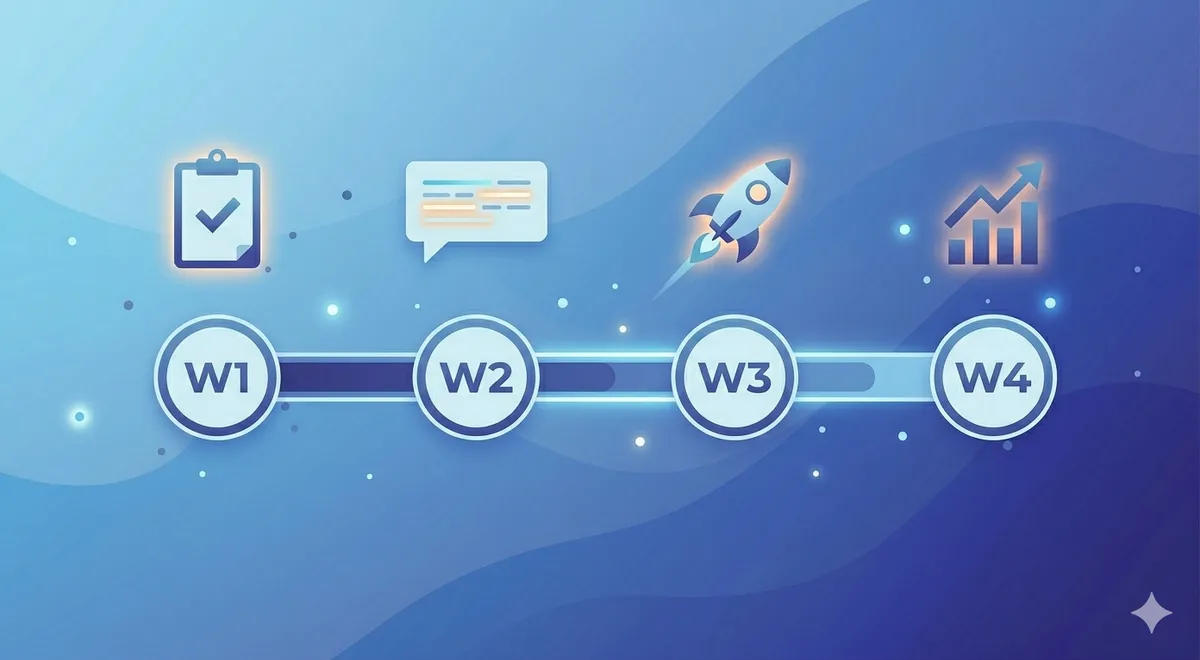
Week 1: ICP and Signal Design
Week one is all about understanding your market. This is where the lead gen partner learns who you sell to, why those companies buy, and what observable behaviours indicate they're ready to talk. It's the most important week of the entire onboarding because every decision that follows — messaging, targeting, channel selection, signal monitoring — depends on getting this right.
The kickoff meeting should be at least 90 minutes. It's not a formality — it's a deep-dive working session. The partner's team should come with questions, not just a questionnaire. They need to understand your product, your market, your competitive landscape, your typical deal cycle, and your sales team's capacity and preferences. If the kickoff feels like a checkbox exercise, that's a warning sign.
ICP definition goes beyond basic firmographics. Yes, you'll cover company size, industry, geography, and revenue range. But the real value comes from the nuances: which sub-industries convert best? Are there company characteristics (growth stage, funding status, tech stack) that predict fit? What job titles buy your product, and what titles influence the buying decision? Are there companies that look like a fit on paper but consistently don't convert — and why?
The best partners will also ask about your existing customer base. What do your top 10 customers have in common? What's the average deal size? What was the trigger that made them start looking? What objections came up during the sales process? This isn't idle curiosity — it's calibration data. The patterns in your existing customers are the blueprint for finding new ones.
Signal design is where ICP meets intent. Based on the ICP, the partner maps out which signals are most likely to indicate buying behaviour for your specific market. For a cybersecurity company, a hiring signal for a CISO might be the strongest indicator. For a CRM vendor, a series of pricing page visits from multiple people at the same company is the signal. For a consulting firm, a funding round or acquisition announcement might be the trigger.
By the end of week one, you should have a documented ICP with specific, testable criteria, a signal map that shows which behaviours the partner will monitor and how they'll be weighted, and a target account list of 200–500 companies that meet the ICP and will be the initial outreach universe.
If you're not sure how to structure your ICP for signal-based outreach, our signal-to-scheduled-call walkthrough covers how ICP and signals work together in practice.
Week 2: Playbooks, Messaging, and Infrastructure
Week two is about building the machine. You've defined who to target and what signals to watch for. Now you need the messaging to reach them, the infrastructure to deliver it, and the playbooks that tie everything together.
Outreach playbooks are structured sequences of messages across one or more channels (typically email and LinkedIn, sometimes phone). Each playbook is built for a specific signal type and buyer persona. A playbook for a "new VP hire" signal will have different messaging than one for a "pricing page visit" signal, even if the target company is the same. The playbook defines the channel, the number of touchpoints, the timing between touchpoints, the message content, and the escalation path if there's no response.
A well-built onboarding typically produces 3–5 playbooks to start. One for your primary signal type (the one most likely to produce results), one for your secondary signal type, and one or two variants for different personas or market segments. You don't need a playbook for every possible scenario — you need enough to cover your highest-probability paths, with the flexibility to add more as you learn what works.
Messaging is where many lead gen partnerships go wrong. The partner writes outreach copy that sounds like them, not like you. It's too salesy, too formal, too casual, or too generic. The fix is collaborative copy development. In week two, the partner should draft initial outreach messages and share them for your review and feedback. You should hear your voice in those messages — or at least a version that you're comfortable having represent your brand.
Pay close attention to the opening line of each message. That first sentence determines whether the email gets read or deleted. It should reference the signal that triggered the outreach, be specific to the recipient's company or role, and create a reason to keep reading. Generic openers like "I'd love to connect" or "I thought you'd be interested in our platform" are immediate deletes for most B2B buyers.
Infrastructure setup runs in parallel with messaging. This includes:
- Outreach domains — Dedicated domains for email outreach, separate from your primary business domain, with proper SPF, DKIM, and DMARC configuration
- Domain warming — Gradually increasing email volume over 2–3 weeks to build sender reputation before full-volume outreach
- Email infrastructure — Mailboxes, sending limits, rotation schedules, and deliverability monitoring
- CRM integration — Connecting the outreach system to your CRM so that leads, activities, and meeting data sync automatically
- Tracking and reporting — Dashboards or reports that show signal volume, outreach activity, response rates, and meeting pipeline
Domain warming is the biggest bottleneck in this week. It needs to start early because it takes 2–3 weeks of gradual sending to build enough reputation for reliable inbox placement. If the partner hasn't started warming by the end of week one, it'll push the first real outreach into week four or five.
By the end of week two, you should have approved outreach playbooks with messaging for each signal type, infrastructure set up and warming in progress, CRM integration configured, and a reporting framework in place so you can track progress from day one of outreach.
Week 3: Launch and First Outreach
This is the moment everything comes together. The ICP is defined, the signals are being monitored, the playbooks are built, the messaging is approved, and the infrastructure is warm (or warm enough for a controlled launch). It's time to start reaching out to real prospects.
But week three isn't about going full throttle. It's a controlled launch — lower volume, close monitoring, rapid iteration. The goal is to validate that the system works before scaling up. Think of it as a soft opening for a restaurant. You want real customers (real prospects), but you also want the ability to catch problems early and fix them before they compound.
A typical week three launch starts with 20–30% of target volume. If the plan is 100 outreach contacts per week at steady state, week three might send to 25–30. This keeps the volume manageable for monitoring and creates enough data to evaluate initial performance without burning through the entire target list.
What to monitor during the soft launch:
- Deliverability — Are emails landing in inboxes or spam folders? Bounce rates should be under 3%. Spam complaints should be near zero.
- Open rates — Are subject lines and sender names working? Initial open rates should be 40–60% for warm, personalised outreach. Below 30% suggests deliverability issues or weak subject lines.
- Reply rates — Are people responding? Early reply rates of 5–10% are healthy. Below 3% means the messaging, targeting, or timing needs adjustment.
- Reply sentiment — Are the replies positive ("Tell me more"), neutral ("Not now"), or negative ("Remove me")? The ratio tells you whether the targeting and messaging are resonating.
- LinkedIn acceptance rates — Are connection requests being accepted? Rates above 30% indicate good targeting; below 15% suggests the connection message needs work.
Daily check-ins during week three are normal and expected. The partner should be reviewing performance data daily, sharing observations, and making tactical adjustments. Maybe the subject line for playbook A needs a tweak. Maybe the LinkedIn message for persona B is too long. Maybe the signal threshold needs tightening because too many low-fit companies are getting through. These are all normal calibration findings — the important thing is that they're caught and addressed quickly.
By the end of week three, you should have your first real prospect responses. Some of those might already be progressing toward meetings. Don't panic if the numbers are small — the sample size is still too low to draw firm conclusions. But you should see directional evidence that the system works: emails are being delivered, messages are getting opened, and some recipients are engaging. If you're seeing zero engagement after a full week of outreach, something fundamental is off and needs to be diagnosed before scaling.
Week 4: Review, Optimise, and Scale
Week four is where the partner starts to earn their keep. The controlled launch data from week three is in, and now it's time to review, optimise, and ramp toward full volume. This is the transition from "building the system" to "running the system" — and the quality of this transition determines your experience for the next several months.
The week four review should be a structured session (60–90 minutes) with the partner's team. Walk through every stage of the funnel:
- How many signals were detected? Were they the right types and from ICP-matched companies?
- How many outreach contacts were generated from those signals? What was the ICP match rate?
- How many emails and LinkedIn messages were sent? What were the deliverability metrics?
- How many replies came in? What was the sentiment breakdown?
- How many meetings were booked or in progress? What's the quality of those meetings?
Based on this review, the partner should present an optimisation plan. This typically includes adjustments to messaging (rewriting underperforming templates, testing new subject lines, refining value propositions), targeting refinements (tightening or loosening ICP criteria based on what's converting), signal tuning (increasing weight on signals that correlated with positive responses, decreasing weight on signals that produced noise), and volume scaling (increasing outreach volume toward the steady-state target over the next 2–3 weeks).
Scaling should be gradual. Going from 30 outreach contacts per week to 100 overnight is risky. A better ramp is 30 → 50 → 75 → 100 over weeks 4–7. This protects email deliverability (sudden volume spikes trigger spam filters), gives the partner time to handle increased reply volume, and ensures quality doesn't drop as quantity increases.
By the end of week four, you should have a clear picture of what's working, what needs improvement, and what the next 30 days will look like. You should have a steady-state plan that defines expected volume, target metrics, reporting cadence, and review schedule. And you should have your first few pipeline-quality meetings — proof that the system works and a foundation to build on.
The transition to steady state isn't the end of optimisation — it's the beginning of continuous improvement. But if weeks 1–4 were done well, the improvements from here are incremental (better subject lines, tighter signal weighting, new playbook variants) rather than fundamental (rethinking the ICP, rebuilding the messaging, starting over on infrastructure). That's the payoff of a thorough onboarding: a system that works from week five onward and gets better every month.
What to Prepare Before Kickoff
The quality of the onboarding depends as much on your preparation as on the partner's process. Here's what you should have ready before the first kickoff call so that week one starts running, not gathering.
Your ICP draft. Even a rough version helps. List the industries you serve, the company sizes that fit, the job titles that buy, the geographies you cover, and any deal-breakers (companies you won't work with, industries that are a poor fit). The partner will refine this, but starting from a blank page wastes the first few days.
Your top 10 customer profiles. Export a list of your 10 best existing customers with basic details: company name, industry, size, the role who bought, the deal size, and — if you have it — what triggered them to start looking for a solution. This is the calibration data the partner needs to find more companies like the ones that already buy from you.
Your sales process overview. How does a lead currently become a customer? What are the stages? Who handles each stage? What's the average deal cycle? What's the typical close rate? This helps the partner understand where their work fits in the bigger picture and what "success" means in the context of your sales funnel.
CRM access or an integration plan. The partner will need to sync data with your CRM — typically Salesforce, HubSpot, or Pipedrive. Before kickoff, confirm that your CRM can accept the integration (API access, admin permissions, custom field creation). If your CRM is complex or heavily customised, flag this early so the partner can allocate extra time for integration setup.
Brand and messaging guidelines. How does your company talk? Formal or casual? Technical or plain language? Are there words or phrases you always use — or never use? Share any existing brand guidelines, homepage copy, case studies, or sales decks that represent your voice. The partner needs to sound like an extension of your team, not a generic outsourced operation.
Availability commitments. The partner will need regular access to someone on your team during onboarding — typically for reviews, approvals, and feedback. Identify who that person is (or people, if multiple stakeholders are involved), block 2–3 hours per week on their calendar for the first four weeks, and make sure they're empowered to make decisions. An onboarding that stalls because approvals take a week is an onboarding that takes two months instead of four weeks.
For more context on the full signal-to-meeting journey that onboarding supports, explore our AI-powered lead generation page or book a call to discuss your specific situation.
Frequently Asked Questions
What if my partner says they can launch in one week — is that a red flag?
It depends on what they mean by "launch." If they mean they can start domain warming and initial signal monitoring in week one, that's reasonable and actually a sign of good process. If they mean they'll have full outreach running with personalised messaging by day seven, that's almost certainly a red flag. Real onboarding — ICP definition, messaging development, infrastructure setup, domain warming — takes time. A partner who promises full launch in one week is either cutting corners on setup (which will show in the results), using entirely generic messaging (which won't convert well), or has a very different definition of "launch" than you do. Ask what exactly will be running in week one and what the ramp timeline looks like.
How much of my team's time does onboarding actually require?
Plan for 3–5 hours per week during the four-week onboarding, mostly concentrated in the first two weeks. Week one involves the kickoff deep-dive (90 minutes), ICP review and feedback (60 minutes), and signal design review (30–60 minutes). Week two involves playbook and messaging review (60–90 minutes), infrastructure and CRM coordination (30–60 minutes), and approval of final outreach sequences (30 minutes). Weeks three and four are lighter — mostly reviewing initial performance data (30 minutes each) and providing feedback on early responses. After onboarding, the ongoing time commitment drops to about 30–60 minutes per week for performance reviews and feedback. Designate one person as the primary contact to avoid coordination overhead.
What if we realise during onboarding that our ICP needs to change?
This happens more often than you'd expect, and it's actually one of the benefits of a structured onboarding process. When you go through ICP definition with a lead gen partner, you're forced to articulate assumptions that may never have been tested. Sometimes the partner's data shows that a segment you thought was ideal actually has low engagement, or that a segment you'd overlooked converts at twice the rate. The onboarding is designed to catch this. A good partner will be flexible and adjust the ICP based on evidence rather than sticking rigidly to your initial brief. The key is to treat the ICP as a living document that gets refined during onboarding and continues to evolve based on performance data. The first version is a hypothesis. The version you have at month three is based on evidence.
Should I share my competitor list during onboarding?
Yes, and don't hold back. Your lead gen partner needs to understand your competitive landscape for two reasons. First, they need to position your outreach messaging against the alternatives your prospects are evaluating. If your competitors lead with price and you lead with quality, the messaging needs to reflect that differentiation. Second, competitive intelligence is a signal source — companies evaluating your competitors (reviewing their products, visiting their comparison pages, searching for alternatives) are potential targets. A partner who knows your competitor landscape can build outreach sequences that specifically address why prospects switch from Competitor A, or what Competitor B doesn't offer. Withholding competitor information means the partner is working with incomplete context, which leads to weaker messaging and missed targeting opportunities.
Can onboarding be done remotely, or do we need in-person meetings?
Remote onboarding works perfectly well for the vast majority of lead gen partnerships. Most partners operate remotely by default and have refined their onboarding processes for video calls, shared documents, and asynchronous collaboration. The key success factors are consistent video call availability during weeks 1–2 (not just email), a shared workspace for documents, ICP criteria, messaging drafts, and feedback (Google Docs, Notion, or similar), and quick turnaround on approvals (within 24 hours where possible). In-person meetings are nice-to-have but rarely necessary. If you're working with a local partner and the option is available, a single in-person kickoff session can build rapport and deepen understanding. But it's not a requirement, and insisting on in-person meetings can actually slow down an onboarding that benefits from rapid, asynchronous iteration between calls.
Ready to Start Your 4-Week Onboarding?
Totalremoto follows this exact onboarding framework. We start with a deep-dive into your ICP and signal design, build personalised playbooks around your voice and your market, set up compliant infrastructure with full CRM integration, and launch controlled outreach by week three. By week four, you're seeing real meetings with ICP-matched prospects who showed genuine buying intent.
Want to see the onboarding in action? Pick a plan or book a call — we'll walk you through exactly what the first four weeks look like for your business.